

Lyrics
He was agin the rich
He was agin the rich
He was agin the poor
He was agin the poor
He was agin the rich
He was agin the poor
He was agin the rich
He was against all trepidation 1
He was agin the rich
On the loose again
He was agin the rich

There's a new fiend on the loose 2
On the back of the exhaust clip 3
Clipped on rich and poor alike
Come to roost again once more

Ol' Nick doesn't go from digs to digs no more 4
Hit him on the head with a two-by-four 5
Nowadays he has a Georgian glazed porch 6

He was agin the rich
He was agin the rich (poor) 7
He was agin the poor
He was agin the poor

There's a new fiend on the loose
On the back of the exhaust clip
Clipped on rich and poor alike
Come to roost again once more

He said hit him on the head with a two-by-four
He said hit him on the head with a two-by-four

He was agin the rich
He was agin the poor
He was agin the poor
Used table leg to club son-in-law 8

New fiend again in your home my friend 9
New fiend in your home again
Two-by-four
New friend in your home my fiend 10

He said show me my quarters and glasses 11
He said show me my quarters and glasses

There's a new fiend on the loose
Jolting in his tradition 12
It's a fear of the obtuse
He's got patents on the moaning
Commentary
2 by 4
INTO our midst came fiend… into our midst, came Friend. Stomachs gnawed as Trak of fame debuted on KGB pantomime t.v. show one Friday, ‘boh’.
From the sleeve notes to The Wonderful and Frightening World of… (1984).
Note, re: reference to a Friday TV show, that The Fall appeared on Channel 4’s music programme The Tube on Friday 25 November 1983, introduced by Jools Holland and John Peel. The Fall performed “Smile” and “2 x 4”.
“2 x 4” was first performed (on the evidence of gig recordings) at Rock City, Nottingham, on 27th September 1983. It was last heard at the John Anson Ford Theater, Los Angeles, on 27th May 1988. It therefore lasted for almost all of Brix’s first stint with the group. It would appear on record (LP and cassette) for the first time as the second track on The Wonderful and Frightening World of… (released 12th October 1984), preceded by a Peel Session recorded on 12th December 1983 and first broadcast on 3rd January 1984. It was also, memorably, performed on the Channel 4 pop/rock show The Tube on 25 November 1983, with Karl Burns and Paul Hanley on drums and Brix joining the group on guitar (after sitting out the performance of “Smile”).
The song was originally titled “New Fiend”: the song is listed as “N. Fiend” on the setlists from the gigs at Buster Browns, Edinburgh (4th October 1983) and the Concord Bar, Brighton (27th October 1983). It is not known when the title was changed.
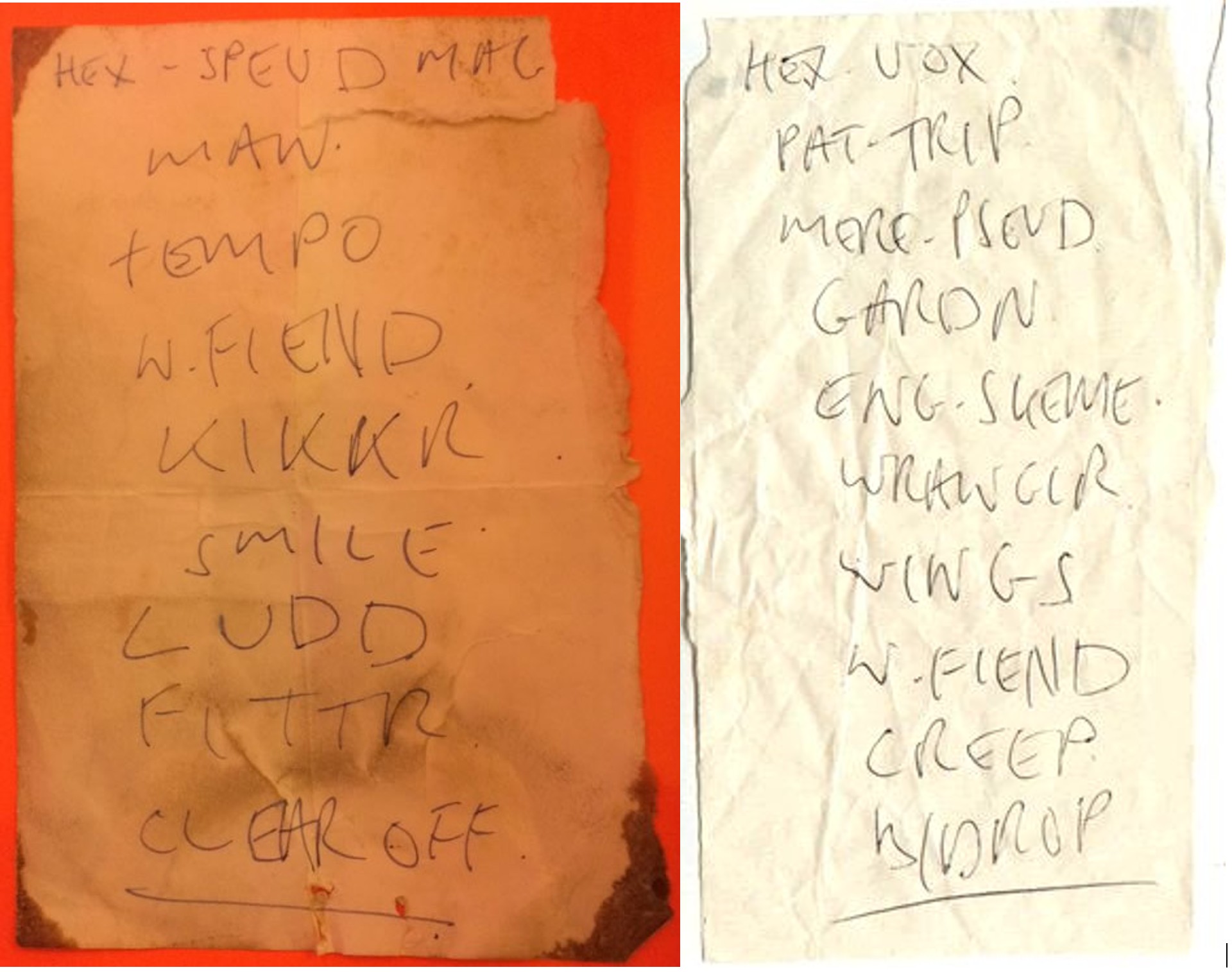
“2 x 4” is musically unusual, if you know what to listen for. According to Paul Hanley, during the @Tim_Burgess curated #timstwitterlisteningparty for The Wonderful and Frightening World of… :
the Verse is in 4/4 but the chorus is in 5/4 – to make matters even stranger Steve plays the chorus over the verse at a couple of points. @jasonbrown001 out of the Extricated was the one who pointed out how weird that was. Never occured to us.
Paul Hanley (@hanleyPa), on what was then Twitter, 2:07PM, 2 April 2020. See Burgess (2021, p.42) [Link to Twitter]
Lyrically it seems that the “new fiend” is to be identified with The Devil, but this is not certain. Perhaps, given that The Devil is apparently no longer itinerant but occupies a middle class home with a “glazed porch”, the “new fiend” is a demonic competitor? Nor is it clear who the “he” is who is against the rich and/or the poor. Is that also the “new fiend”/Devil? Or are they different characters? So when we get to the line “He said hit him on the head with a two-by-four”, it’s not entirely obvious whether the instruction is to hit The Devil on the head, or whether The Devil is giving the instruction. And if the “son-in-law” has been clubbed over the head with the length of wood, does that mean the “son-in-law” is demonic, or an innocent victim of Satanic suggestion, or what? See the notes for some discussion of how to interpret the “son-in-law” line.
“2 x 4” was the first Fall song that Brix contributed to (and it is credited to Mark E. Smith and Brix on the album). In The Rise, The Fall, And The Rise, Brix writes:
The first song I brought in that we played on that tour was 2 x 4’. I would write the songs at home on the couch in front on the TV with my guitar unplugged. I wrote all the earliest songs for The Fall on my beloved cherry-red Gretsch. ‘2 x 4’ had a great rockabilly rhythm. I played it to Mark and said, ‘Look what I came up with.’ He was like, ‘Great.’ He would take out his Sony cassette recorder, and we would record it at home. Then the next time we would go into the rehearsal room I played it to the guys. I brought in the skeleton of a song. They would add the flesh, bones and blood. Pretty soon, the song had just developed.
In England, they don’t have ‘2 x 4’s, which is a non-metric term for a wooden plank. That image is from watching so many cartoons as a child – Road Runner hitting Wile E. Coyote with a two-by-four. It was that kind of imagery.
Smith-Start, 2016, pp.184-185.
See also Burgess (2021, p.42) for a similar account, taken from the Tim Burgess “Listening Party” dedicated to The Wonderful and Frightening World of… held on Twitter on 2 April 2020: “It’s called 2X4 because I grew up watching cartoons & in America we call a plank of wood a 2X4. I remember Wiley Coyote and Roadrunner whacking each other with a 2X4. So I said to Mark, I want to say “Hit him on the head with a 2X4″ and Mark wrote the lyrics.” [Link to Twitter]
See below for discussion of another source of the “hit him on the head with a 2 x 4” line.
Brix isn’t quite right about the “two-by-four” terminology. The U.K. didn’t adopt an official policy of metrication until 1965, a move that was required for admission to the European Economic Community in 1973. Metrication proved politically controversial, with the result that there has never been a wholescale imposition of Metric units across the board. Imperial and Metric units have therefore co-existed for decades (and were confusingly taught alongside each other when I was at school in the 1970s and 1980s, as a consequence of which I use Metric units for some purposes, and Imperial units for others!), and would be familiar to both young and old. However, in British English, the phrase “four-by-two” is used instead of “two-by-four” (see notes).
Musically and lyrically the song evolved only slightly between the first live outings, the Peel Session, the “New Fiend” alternate mixes, and the final version recorded for The Wonderful and Frightening World of…
The Peel Session, “New Fiend” versions and many early live performances include variations on the lines, “The false pigeons were on roofs again”, and “There’s a new fiend on the loose / Haunted one star restaurant / It’s a zip stream from upstairs, come to roost again once more”, which are not heard on the album version.
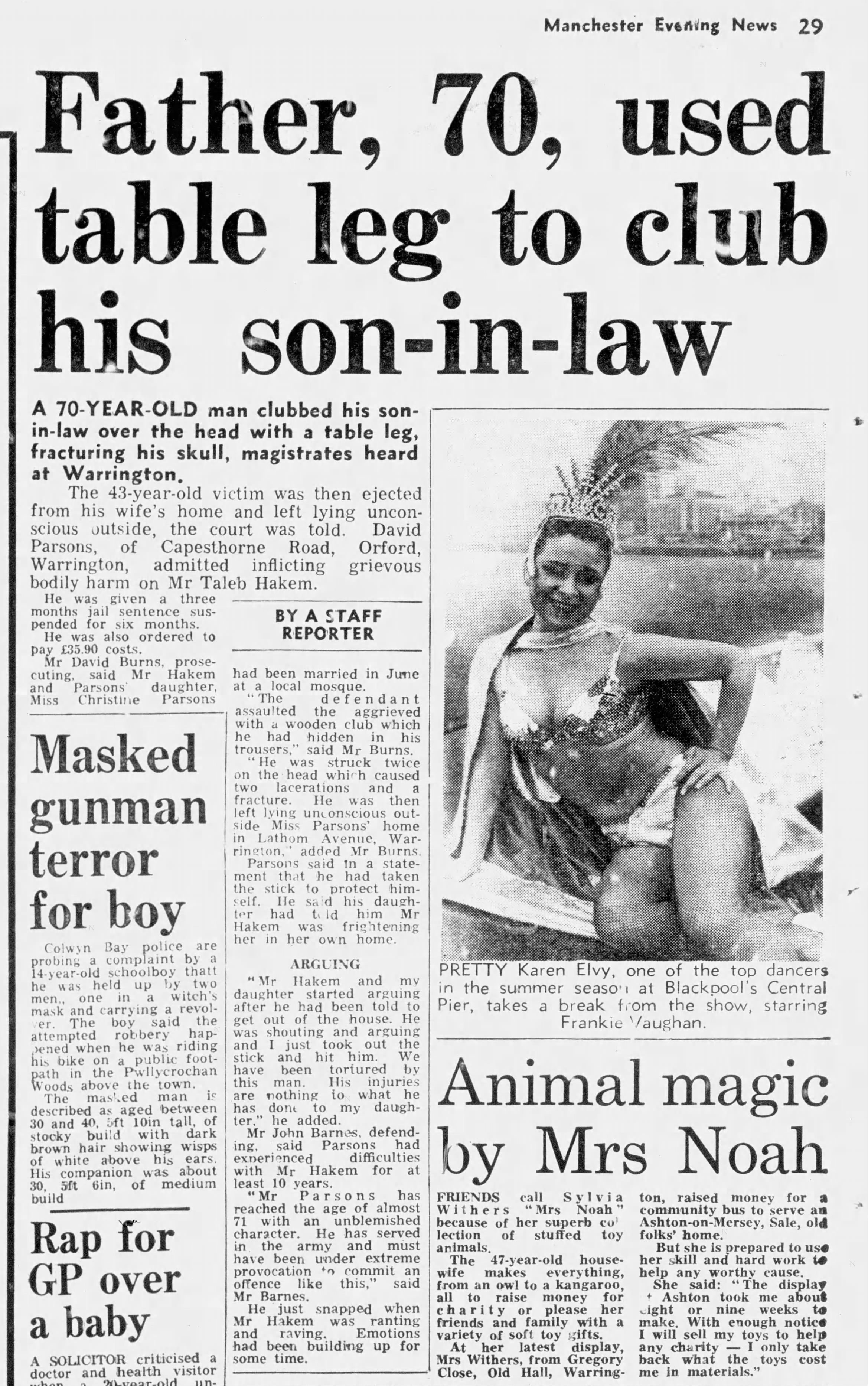
M.E.S. almost certainly got the “used table leg to club son-in-law” line from the following headline which I found in the Manchester Evening News, dated 20 August 1983 (i.e. about a month or so before the song’s live debut). See the notes for more on this.
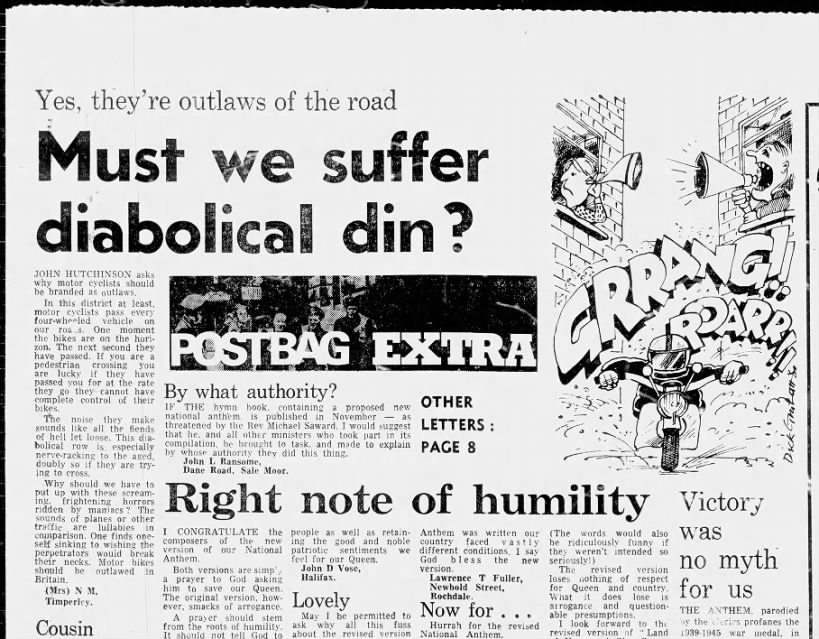
There was also a letter to the Manchester Evening News from a Mrs. N.M. of Timperley, demanding that motorbikes be banned. It includes the deathless line, “The noise they make sounds like all the fiends of hell let loose.” I include this just for that echo, but I don’t favour it as a source because it’s little bit too old.
Notable Versions
As already noted above, several versions other than the album track exist.
The Peel Session version was recorded by Karl Burns, Paul Hanley, Steve Hanley, Craig Scanlon, Brix Smith, and Mark E. Smith in Maida Vale Studio 4. The producer was long-serving Radio 1 staffer Tony Wilson (not that one). The engineer was Martin Colley. The session was repeated a few times.
Previously unreleased versions titled “New Fiend (2 By 4)” and “New Fiend (Rough Mix)” appeared on the “Singles and Rough Mixes” disc of the omnibus edition of The Wonderful and Frightening World of the Fall (2010).
Two eerie versions of the song titled “Fiend with a Violin” and “Fiend with a Violin (Vox)” first appeared on the Fiend With a Violin compilation in 1996. The former is entirely instrumental and just over three minutes long; the latter is under half the length of its companion (a minute and about 15 seconds long) and features brief M.E.S. vocals. The former subsequently turned up on the Northern Attitude compilation in 1998, and the latter on the Archive Series compilation in 1997. They may be demos, but the compilations on which they appear lack any useful documentation. For more on the “fiend with a violin” concept, see below.
Sounds Like… ?
In an article in The Biggest Library Yet fanzine (2000), Rob Waite drew attention to a lyrical borrowing from the Woodie Brothers’ song “Chased Old Satan Through the Door” (1931). The article did not specify what the borrowing actually was, but it turns out that it’s significant.
Now I run old Satan through the door
And I hit him in the head with a two-by-four
Notwithstanding Brix’s statements (see above) that the “two-by-four” line is hers, it is surely wildly implausible that she was not drawing – perhaps unconsciously – on the Woodie Brothers. During the album “Listening Party” referred to above, I asked Brix about the Woodie Brothers; Brix “liked” my Tweet, but did not explicitly confirm a debt of any kind.
Fiend with a Violin
As mentioned above, two alternate versions of “2 x 4” appeared (credited only to “Smith”) under the titles “Fiend with a Violin” and “Fiend with a Violin (Vox)” on the 1996 compilation of the same name. These versions of the song do feature violin, but it isn’t known who is playing it.
I researched Fiend with a Violin‘s cover artwork and discovered it was an adaptation of an 1850s George Cruikshank woodcut depicting The Devil playing a violin with his forked tail.
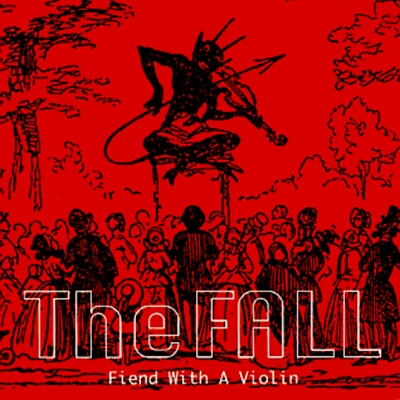
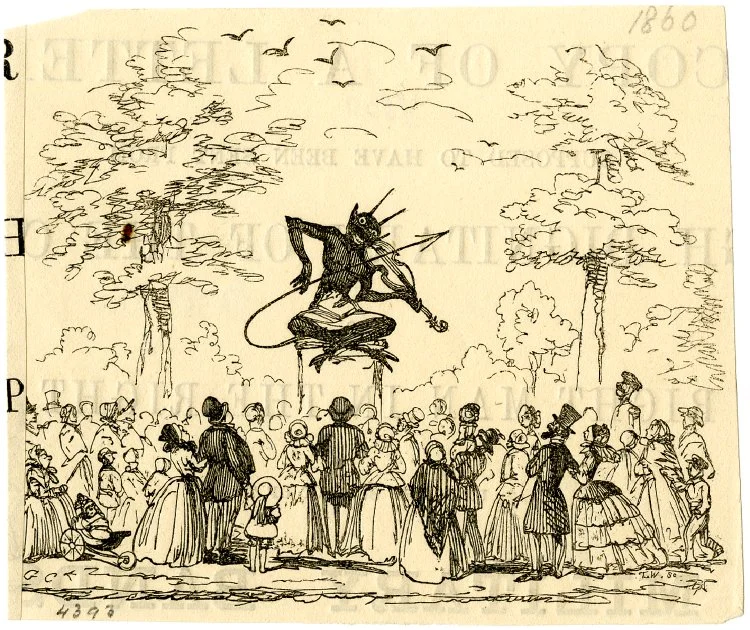
The association of The Devil with dancing, music and specifically the violin has deep roots in folklore. The legend that bluesman Robert Johnson (1911 – 1938) sold his soul to The Devil at a crossroads, in exchange for success as a musician, is well known, as is the older myth about the Italian composer Niccolò Paganini (1782 – 1840), “The Devil’s Violinist” (on Paganini see Kawabata, 2007 and 2013; on both Johnson and Paganini see Everett and Narváez, 2001).
But aside from such Faustian pacts (see “Dktr. Faustus“), the violin itself was often seen as an occult instrument, perhaps because of its “Oriental” origins. Everett and Narváez cite Paganini’s biographer Stephen Stratton, who wrote in 1907 that a precursor of the violin was “the only instrument which, to the present writer’s knowledge, Satan has been represented as playing upon”, and the country music expert Charles Wolfe’s report that the fiddle was known as “The Devil’s Box” in the American South (Everett and Narváez, 2001, p.28). See also Halpert (1943).
Footnotes
- A curious word in context. According to the Shorter Oxford English Dictionary it can mean “Tremulous, vibratory, or rhythmic movement… Also, involuntary trembling of the limbs; tremor.” or “Tremulous agitation; confused hurry or alarm; mental perturbation.” or, in astronomy, “A libration of the sphere of the fixed stars…” What being “against” nervous trembling might practically involve is not immediately obvious. ↩︎
- A couple of minutes into “The Entrancing Dr. Cassandra”, an episode of the camp 1960s TV incarnation of Batman (season 4, episode 25, first broadcast 7th March 1968), Bruce Wayne (played by Adam West) remarks to Dick Grayson (played by Burt Ward): “There’s a new fiend in town, Dick.” Note that Batman wasn’t released on video formats until 1985, so if the series is a source then M.E.S. and/or Brix would need to have seen it broadcast – which is obviously possible. However I haven’t identified broadcasts of this particular episode in either the UK or US c.1983 (which doesn’t mean there weren’t any). ↩︎
- I am not mechanically minded, and I am not entirely clear what an “exhaust clip” does. Some sort of a clamp for a motorbike or car, presumably. There is an exhaust systems manufacturer called Devil Exhausts, founded in France in 1966 as “Deville”, after the family who owned the company. See the note on the line about “Old Nick”. ↩︎
- “Old Nick” is a nickname for the Devil. According to the Oxford Dictionary of English Folklore: “… humorous nickname for the Devil… first recorded in the 17th century. Its origins are uncertain, but it may be related to certain German and Scandinavian words beginning in nik-, used for various dangerous supernatural creatures.”
“Digs” are lodgings; short-term accommodation, sometimes but not necessarily consisting of one rented room in a house.
There isn’t really a notably common cultural motif involving Satan moving “from digs to digs”. But note that the Old Testament does present Satan as a wanderer, see Job 1:7 (KJV), “And the Lord said unto Satan, Whence comest thou? Then Satan answered the Lord, and said, From going to and fro in the earth, and from walking up and down in it.” See Bible Gateway. The lyric suggests that Satan has now settled into an archetypically well-to-do middle-class period house.
There is a potential inspiration for this, in Dennis Potter’s Brimstone and Treacle. Originally scheduled for broadcast by the BBC on 6th April 1976, as the first of a trilogy of Potter plays to be shown in the Play For Today slot, it was pulled prior to transmission at the initiative of the BBC’s Director of Programmes, Alasdair Milne, and the Director of BBC-1, Bryan Cowgill. Milne described the play in a letter to Potter as “beautifully written and made, but… nauseating”, apparently because it is suggested (the scene is implied but not depicted on screen) that a young woman who has been disabled in a car accident is “cured” by being raped by Satan (a Devilish figure, at any rate), who has insinuated himself into her parents’ home.
Brimstone and Treacle was eventually shown on 25 August 1987, as part of a Potter retrospective, but in the meantime it was produced as a stage play (premiered at the Crucible Theatre, Sheffield, in October 1977) and for the cinema (1982). The BBC version was directed by Barry Davis and starred Denholm Ellioon tt as Tom Bates, Patricia Lawrence as Amy Bates, Michelle Newell as their daughter Patricia/Pattie, and Michael Kitchen as the demonic Martin Taylor. The film version was directed by Richard Loncraine and again starred Denholm Elliott as Tom Bates, plus Joan Plowright as his wife (called Norma here), Suzanna Hamilton as Patricia/Pattie, and, er, Sting as Martin. It was released on VHS in 1983. Obviously if Brimstone and Treacle is a source, then it has to be the 1982 Loncraine directed version.
“Pigs to pigs” has been suggested as an alternative to “digs to digs”, because of the New Testament story in Mark 5:12 (“And all the devils besought him, saying, Send us into the swine, that we may enter into them.” [KJV]), but it doesn’t really sound like that on record (notwithstanding that once “pigs” has been suggested, it’s hard to hear anything else!). It does sound more like “pigs” on the Peel Session version. ↩︎ - “Two-by-four” is a U.S. colloquialism for a standard cut of wood measuring two inches by four inches in cross section. In British English (and apparently also in Australia and New Zealand) we would say “four-by-two” instead.
An interesting if dubious alternative interpretation was suggested by user @bend at annotatedfall.doomby.com (comment #48, 21st August 2022): the “2 x 4” could be a crucifix (presumably a four-foot length of wood, crossed by a two-foot length of wood, or something). I don’t buy it, but I like the thought.
Why stick with “two-by-four” and not “four-by-two” – American rather than British slang? Well, first of all it rhymes with “more”. Secondly, it’s apparently a line contributed (if not originated) by Brix, who is of course American. Thirdly, “four-by-two” is rhyming slang for “Jew” and considered derogatory – which Mark E. Smith may have known and wanted to avoid. ↩︎ - Georgian architecture refers to architecture dating from the years 1714 to 1830, or resembling architectural styles characteristic of those years, so-called because four British kings, all called George, reigned one after the other during that period: Georges I to IV, all from the House of Hanover.
“Georgian” does have geographical/demonymic meanings which should be noted, i.e. it’s an adjective describing an inhabitant or native of the American state of Georgia or the country on the coast of the Black Sea. In relation to the former, there is the Charlie Daniels Band’s song, “The Devil Went Down to Georgia” (1979). ↩︎ - M.E.S.’s vocals are double tracked, and split at this point, so we get both “rich” and “poor” at the same time. According to the producer, John Leckie (in conversation with Brix on her Boogaloo Radio show, see Smith Start, 2019), the main vocal was actually a guide. There was another take with different lyrical choices, which is layered here to interesting effect. ↩︎
- This line must have been borrowed from the headline “Father, 70, used table leg to club his son-in-law”, from the Manchester Evening News, 20 August 1983, p.29. See Commentary.
It is commonly asserted that the song, or at any rate this line (even though it has been borrowed from a newspaper headline), reflects the hostility of Brix’s family towards Mark E. Smith, or vice versa (or specifically Brix’s father, citing the lines “your horrible new dad with a grudge against me” from “What You Need” and “Her father was much worse” from “Sing! Harpy“). Brix introduced herself to Mark on 23 April 1983, at the gig at the Metro, Chicago. A few days later, according to Brix’s autobiography, he met her mother and Marvin, her step-father (who Brix initially hated but grew to like). Of that first meeting, Brix writes, “Mom and Marvin are wonderful people and truly non-judgemental. If they had any misgivings about Mark, they never let me know.” (Smith-Start, 2016, p.154). This doesn’t sound like the kind of experience that would lead to a lyric about being beaten with a plank of wood.
However, the end of The Fall’s U.S. tour, Mark and Brix were temporarily separated, setting 18th May – two weeks away – as the date Brix would fly to join Mark in England and get married. Brix’s mother was furious at learning of Brix’s intentions, but Marvin, though he was furious too according to Brix, kept out of it. None of Brix’s family attended the wedding in July 1983, Brix having decided too late to ask her mum to be there (Smith-Start, 2016, p.154).
Brix writes, “When I listen to the lyrics now, for his part, it’s evident that Mark was talking about my family’s perception of him. There’s a line where he goes ‘used table leg to club son-in-law’. He would always write songs about members in the band, but for some reason I thought that, as the wife, I was exempt.” (Smith-Start, 2016, p.185). This is a retrospective interpretation, rather than something she thought at the time. There is no indication she was aware of the newspaper headline.
On the other hand, Mark E. Smith told Sounds‘ Ron Rom (1986, p.21) that “I know Brix loves her stepfather and I get on really well with her real father, he comes out with sick jokes all the time.” No sign of a particularly difficult relationship there, though of course things may simply have improved since 1983.
We must of course take Brix’s interpretation seriously, but it remains possible that Mark didn’t intend the lyric to be personal and was just struck by the “used table leg to club his son-in-law” headline and saw that it would fit with Brix’s borrowed “two-by-four” lyric.
The found headline is serendipitous, and might have been pressed into lyrical service regardless, but it seems to me that the very recently married M.E.S. would be very likely to think it would be hilarious to insert the “son-in-law” line into the song. But that doesn’t mean the entire lyric is meant to be personal: there’s no other evidence in the text that points to that.
An interesting association, albeit we don’t know it to be deliberate, is to the 1930s blues musician William Bunch (1902 – 1941), whose stage name was Peetie Wheatstraw. According to Wikipedia, “all but two of his records were issued under the names ‘Peetie Wheatstraw, the Devil’s Son-in-Law’ and ‘Peetie Wheatstraw, the High Sheriff from Hell’”. There is a “blaxploitation” film titled Petey Wheatstraw: the Devil’s Son-in-Law (dir. Cliff Roquemore, 1977). For more on Bunch/Wheatstraw see Garon (1971). Another connection is Battaglia de Barabaso yerno de Satanas (in English, Battle of Barabaso, son-in-law of Satan) – a piece by the 16th/17 century composer Andrea Falconieri. ↩︎ - I enjoy this fiend/friend wordplay, reversed a couple of lines later. ↩︎
- Reversing the fun wordplay of a couple of lines earlier. ↩︎
- Quarters can mean living accommodation (i.e. digs, see above) and glasses can mean spectacles. One might need to be shown the former, but probably not the latter. But “quarters and glasses” could also be a reference to a drinking game (known as “Quarters“), the aim of which is to bounce 25-cent/quarter-dollar coins off a table into a shot glass.
Curiously, though not relevantly, during Brett Kavanaugh’s U.S. Supreme Court confirmation hearings a reference in his high school yearbook entry to “Devil’s Triangle” was queried and turned out – according to Kavanaugh – to refer to a variation on Quarters in which the target shot glasses were arranged in a triangle. ↩︎ - annotatedfall.doomby.com user @harleyr pointed out (comment #47, 16th August 2002) that the front-cover tagline of EC Comics was “Jolting Tales of Tension in the EC Tradition”. It is unknown if this is an intentional reference. ↩︎
Sources / Links
- The Annotated Fall: “2 x 4” [Archived]
- BFI Screenonline: Brimstone and Treacle (1987)
- Burgess, Tim (2021). The Listening Party. London: Dorling Kindersley.
- Everett, Holly, and Narváez, Peter (2001). “‘Me and the Devil’: Legends of Niccolo Paganini and Robert Johnson”. Contemporary Legend, Vol. 4, December. pp.20-47. [Available online at: https://scholarworks.iu.edu/journals/index.php/cl/article/view/34959].
- Ford, Simon (2003). Hip Priest: the story of Mark E Smith and The Fall. London: Quartet Books.
- Garon, Paul (1971). The Devil’s Son-in-Law: the Story of Peetie Wheatstraw and his Songs. London: Studio Vista/November Books. [Available online in archive.org]
- Halpert, Herbert (1943). “The Devil and the Fiddle”. Hoosier Folklore Bulletin, Vol. 2 (2), December. pp.39-43. [Available online at: https://www.jstor.org/stable/27655458]
- Kawabata, Maiko (2007). “Virtuosity, the Violin, the Devil… What Really Made Paganini “Demonic”?” Current Musicology, no. 83, Spring. pp.85-108. [Available online]
- Kawabata, Maiko (2013). Paganini: The “Demonic” Virtuoso. Woodbridge: The Boydell Press.
- Mackay, Tommy (2018). 40 Odd Years of The Fall. Place of publication unknown: Greg Moodie.
- Pringle, Steve (2022). You Must Get Them All: The Fall on Record. [paperback edition]. Pontefract: Route Publishing Ltd. [Online store]
- Rom, Ron (1986). “Semi-Detached Suburban Mr Smith”. Sounds, 19 July, pp.20-21. [Text available online via thefall.org]
- Smith Start, Brix (2016). The Rise, The Fall, and The Rise. London: Faber & Faber. [Text available online in archive.org]
- Smith Start, Brix (2019). “The Brix Show” (with special guest John Leckie). Boogaloo Radio, 2 January. [Available online via MixCloud]
- The Track Record: “2 x 4”
- Waite, Rob (2000). “Notebooks Out”. The Biggest Library Yet, issue 18, January. p.7.
- Wikipedia: Brimstone and Treacle (1982)
- Wikipedia: Metrication in the United Kingdom
- Wolstencroft, Simon (2014). You Can Drum But You Can’t Hide: a memoir. Trowbridge: Strata Books. (2nd edition published by Route Publishing, 2017).