I'm totally wired
Totally wired
(Totally wired)
I'm totally wired
(Can't you see?)
Totally wired
Can't you see?

A butterfly stomach round ground 1
I drank a jar of coffee, and then I took some of these

And I'm totally wired
Totally wired
(Totally wired)
I'm totally wired
(Can't you see?)
Totally wired

Life leaves you surprised
Slaps you in the eyes
If I was a communist, a rich man'd bail me 2
The opposite applies
The morning light
Another fresh fight
Another row, right, right, right, right

And I'm totally wired
T t t t totally wired
(Totally wired)
I'm totally biased
(Can't you see?)
Totally wired

You don't have to be weird to be wired
You don't have to be an American brand
You don't have to be strange to be strange
You don't have to be weird to be weird 3

But I'm totally wired
Totally wired
(Totally wired)
T t t t totally wired
(Can't you see?)
I'm totally wired

My heart and I agree 4
My heart and I agree
I'm irate, peeved, irate, peeved, irate, bad state, bad state

Cos I'm totally wired
I'm totally wired
(Totally wired)
T t t t totally wired
(Can't you see?)
I'm totally wired

And I'm always worried
And I'm always worried
And I'm always worried
And I'm always worried
Commentary
< Post in progress >
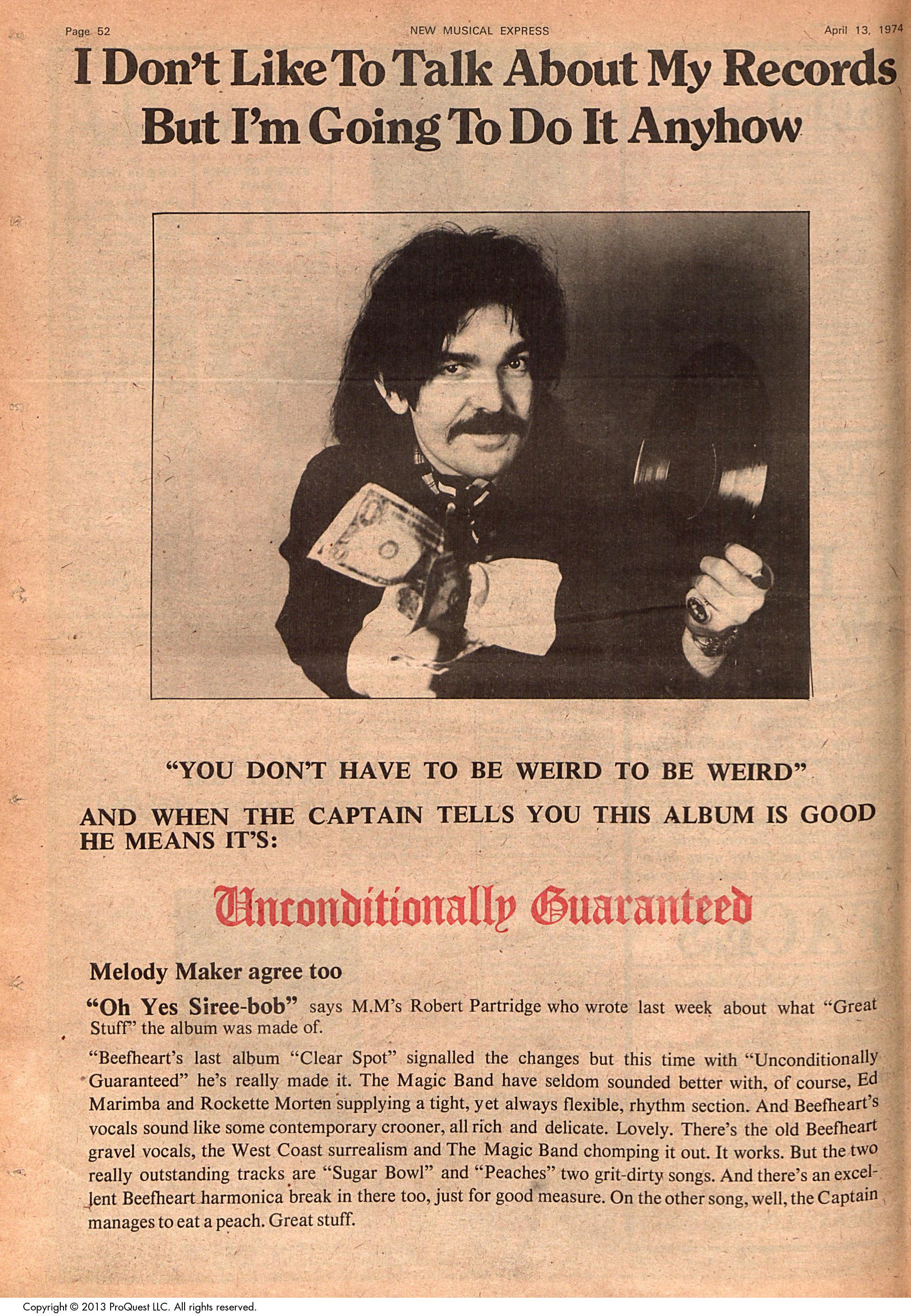
“I don’t like to talk about my records but I’m going to do it anyhow”. Advert for Captain Beefheart’s album Unconditionally Guaranteed (1974) from New Musical Express, 13 April 1974, p.52. Note the line “You don’t have to be weird to be weird”, which MES borrowed for “Totally Wired”.
A Part of American Therein version
Lyrical variant, as heard on the version of “Totally Wired” included on A Part of America Therein (1982) (quite a bit of uncertainty in the transcription here):
You don't have to be weird to be wired
You don't have to be a dyed hair punk funk shit-hot fucked up tick-tock pad
You don't have to be strange to be strangled
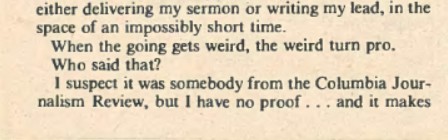
When the going gets weird, the weird turn pro
The line “when the going gets weird, the weird turn pro” is taken from Hunter S. Thompson’s essay, “Fear and Loathing at the Superbowl”, originally published in Rolling Stone, 28 February 1974, p.29. (See the notes to the Thompson (1974) citation in Sources/Links, below):
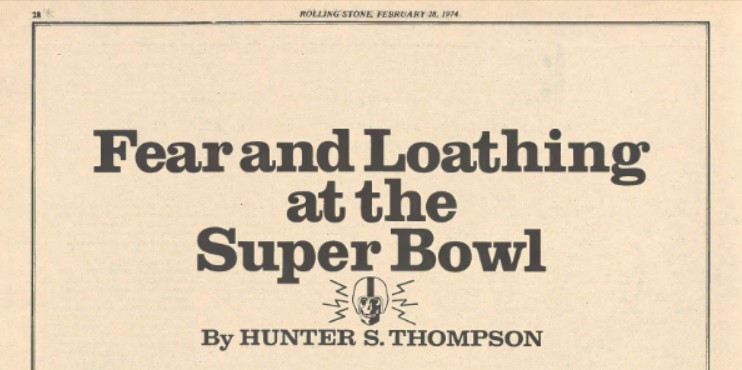
Thompson, Hunter S. (1974). “Fear and Loathing at the Super Bowl”. Title page, Rolling Stone, 28 February. p.28.Thompson, Hunter S. (1974). “Fear and Loathing at the Super Bowl”. Rolling Stone, 28 February. p.29.
When the going gets weird, the weird turn pro.
Who said that?
I suspect it was somebody from the Columbia Journalism Review, but I have no proof … and it makes no difference anyway.
Footnotes
“Butterflies in the stomach” is a common side-effect of taking amphetamines. ↩︎
Some hold that “bail me” should be “fail me”, and for a long time that’s all I could hear too. But not only does it sound like “bail” to me now, it also works better in context: it would indeed be a surprise for a rich man to bail a communist (i.e. to fund their release from prison pending trial). Also, although the lyrics books cannot be taken as infallible in respect of what appears on record, the word is “bail” in what appears to be a draft of the lyrics in the Blue Book (see Smith, 2008). However, it may be that “fail” can be heard in some live renditions of the song, because M.E.S. did vary things. ↩︎
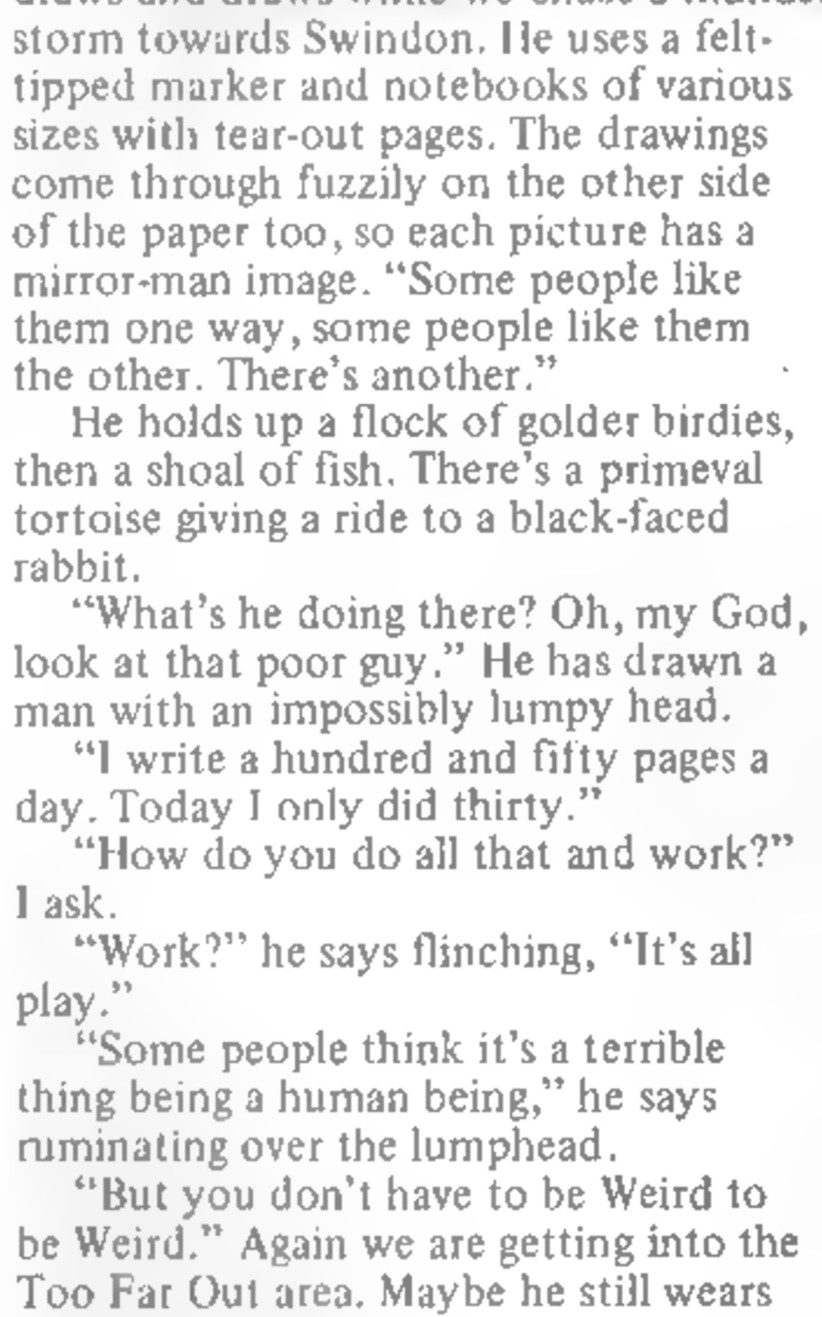
“You don’t have to be weird to be weird” is a Captain Beefheart quotation. It originally appeared in an interview printed in ZigZag magazine, issue #34 (See Barrell, 1973, no page numbering, p.2 of 3):
It was subsequently used in advertisements in the music press for Captain Beefheart and The Magic Band’s 1974 album, Unconditionally Guaranteed:
(Source: New Musical Express, 13 April 1974, p.52) ↩︎
This line may be borrowed from “All My Life”, by Ornette Coleman (1930 – 2015), from his album Science Fiction (1972). The vocals are by Asha Puthli. If this sounds implausible, bear in mind that Mark E. Smith is on record as enjoying Ornette Coleman:
TN: You seem to have, sort of, by the departure of the keyboard player, backed into a phenomenon that’s happening in American jazz drumming. I don’t know if you are familiar with harmelodic music, that certain musicians around Ornette Coleman, particularly a drummer named Ronald Shannon Jackson is doing. Do you ever listen to that sort of music?
MS: It’s funny, because, yeah. I like that. I like Ornette Coleman. That’s about it really. I’m not a great jazz fan. It’s funny, because the drummer definitely don’t listen to jazz. It’s just that I rather like the drum part. With people like Ornette Coleman, they just used to do it. I mean, I have to tell my drummers what to do. But I’m not thinking at all. “This is going to sound like Ornette Coleman”. I’m just trying to find a beat that goes with the song…
(Source: Truly Needy, 1983, p.9)
Captain Beefheart was influenced by Ornette Coleman too.
But also note that “All My Life” in turn quotes from “Stella by Starlight“, composed by Victor Young as an instrumental for the soundtrack of The Uninvited in 1944, but for which Ned Washington wrote lyrics in 1946: “My heart and I agree / She’s everything on earth to me.” ↩︎
Barrell, Tony (1973). “To Be Far Out Or Not To Beefheart Out.” ZigZag, #34, Vol. 3 (10), November. 3pp. No page numbers. [Scanned issue available via worldradiohistory.com. Direct link to PDF] [Text available online via www.beefheart.com]
Ford, Simon (2003). Hip Priest: the story of Mark E Smith and The Fall. London: Quartet Books.
Mackay, Tommy (2018). 40 Odd Years of The Fall. Place of publication unknown: Greg Moodie.
Pringle, Steve (2022). You Must Get Them All: The Fall on Record. [paperback edition]. Pontefract: Route Publishing Ltd. [Online store]
Smith, Mark E. (2008). vII. The Lough Press & AMarquisManipulationProductions. [AKA the Blue Lyrics Book]
Thompson, Hunter S. (1974). “Fear and Loathing at the Superbowl”. Rolling Stone, #155, 28 February. pp.28-38, 42-52. [Reprinted in The Great Shark Hunt (1979) (originally titled, Gonzo Papers, Vol. 1: The Great Shark Hunt: Strange Tales from a Strange Time]. [Note that there is confusion about the year of publication and title of Thompson’s article, apparently because he wrote two with a similar title. “Fear and Loathing at the Superbowl: No rest for the wretched… strobe notes and strange memories on a dreary weekend in Los Angeles” is from Rolling Stone, 15 February 1973. p.10.It’s the 1974 article that is reprinted in The Great Shark Hunt, but the notes to some editions of that anthology – and other sources – get the date and/or the subtitle of the 1974 article wrong. The 1974 article had no subtitle.]