

Lyrics
There's loads of people trying to suss out the scene 1
Sniffing about and sticking their noses in
Rebel
Rebel
Rebel
But she was the littlest rebel

Blue suit with nylon weave
She wears jet-black high heels
She throws Nikes down the well
She's the littlest rebel
Rebel
Rebel
Rebel
But she was the littlest rebel

She consigns them all to hell
She's the littlest rebel

Her tormentors jet past in Nissans
She says, "Are those cars? Are those shoes?"

She consigns them all to hell
She's the littlest rebel
Hips like Shirley Temple 2
She's the littlest rebel
And she doesn't kiss and tell
She's the littlest rebel
Rebel
Rebel
Rebel
But she was the littlest rebel

A sophisticate wastrel
She's the littlest rebel
She doesn't kiss and tell
Cos she's the littlest rebel
She's the littlest rebel
Well ... she's the littlest rebel
Rebel
Rebel
Rebel
And she was the littlest rebel
Rebel
Commentary
< Post in progress >
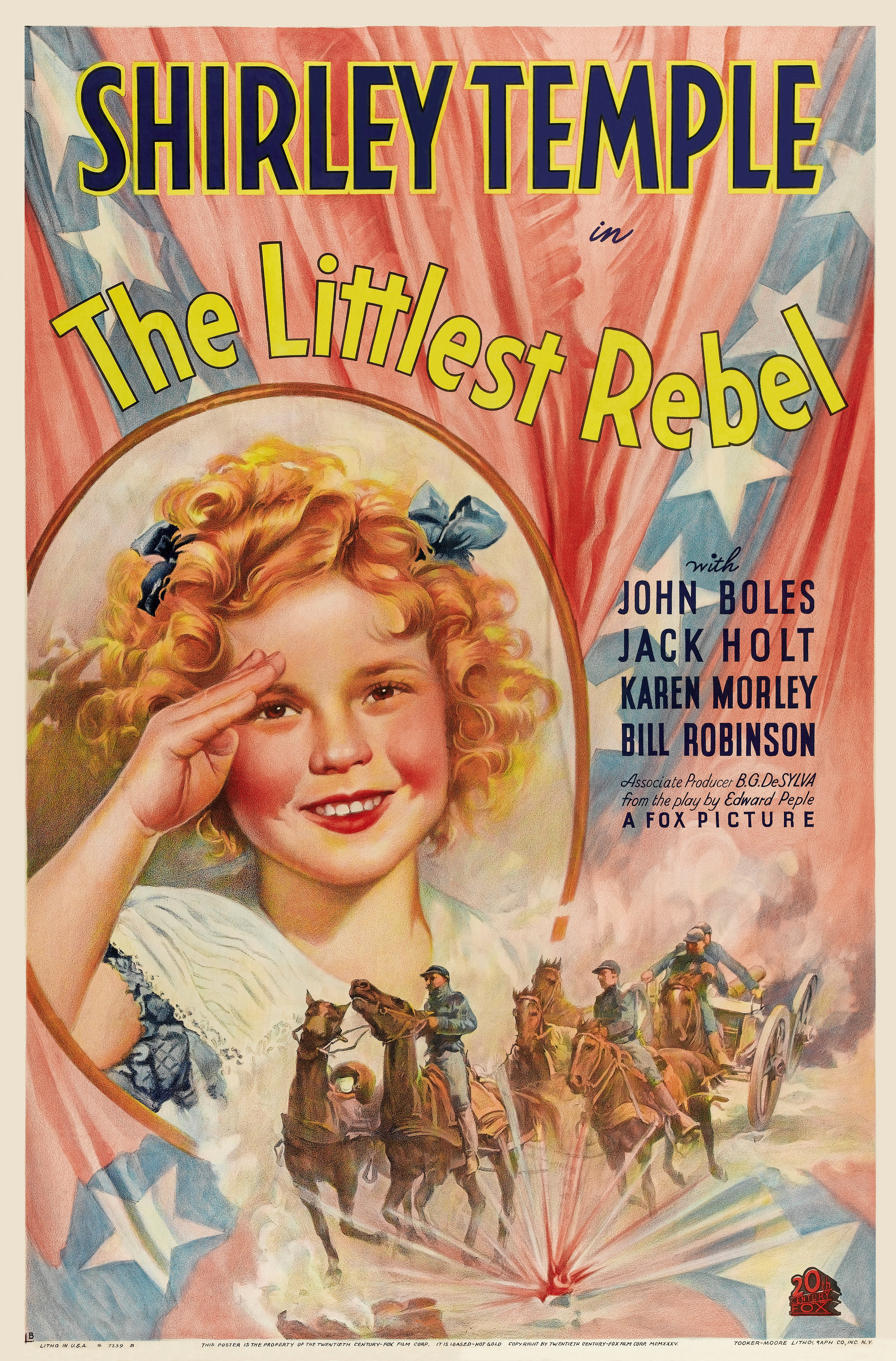
“The Littlest Rebel” takes its title from a 1935 film directed by David Butler and starring Shirley Temple (see Wikipedia). Temple (1928 – 2014) was seven years old when the film was released. “Rebel”, in the context of the film, signifies the secessionist Confederate states at the time of the American Civil War. The film was regularly shown on British and American T.V., but had been broadcast on the UK’s Channel 4 on Sunday 21 May 1989, shortly before the album on which it appears, Extricate, was recorded. Shirley Temple Black, a long-serving diplomat by this point, turned sixty and published her autobiography, Child Star, in 1988 (as far as I can tell, it was published in the U.K. by Headline in the autumn of 1989). A biography of Temple by Anne Edwards was published in late 1988.
Footnotes
- “Suss” as in to investigate, understand, or discover the truth about something. The phrase “suss the scene” appears in “Australians in Europe“. ↩︎
- Temple, as noted, being the child star of the titular movie. M.E.S. amusingly pronounces “Temple” to rhyme with “rebel” in the preceding line (“Reb-el”/”Tem-pel”). It is difficult to know how to interpret this line: is having “hips like Shirley Temple” intended as a complement or an insult? Either way, it seems dubious.
Perhaps M.E.S. was aware of Graham Greene’s jaw-dropping review of Temple’s film Wee Willie Winkie (dir. John Ford, 1937). Published in the short-lived Greene-edited weekly magazine Night and Day (which ran from July – December 1937 and was modelled on the New Yorker), the still-shocking piece alleges a paedophilic edge to Temple’s popularity, which Greene heavily implies was deliberately exploited by Temple’s studio “owners”. He writes:
“…infancy with her is a disguise, her appeal is more secret and more adult. Already two years ago she was a fancy little piece (real childhood, I think, went out after The Littlest Rebel).. In Captain January she wore trousers with the mature suggestion of a Dietrich: her neat and well-developed rump twisted in the tap-dance: her eyes had a sidelong searching coquetry. Now in Wee Willie Winkie, wearing short kilts, she is a complete totsy… Adult emotions of love and grief glissade across the mask of childhood, a childhood skin-deep. It is clever, but it cannot last. Her admirers – middle aged men and clergymen – respond to her dubious coquetry, to the sight of her well-shaped and desirable little body, packed with enormous vitality, only because the safety curtain of story and dialogue drops between intelligence and their desire.” (Greene, 1937).
In fact, some of this was a reheating of comments Greene had made in The Spectator the previous year about another Shirley Temple film, Captain January (dir. David Butler, 1936): “Captain January, the latest Shirley Temple picture, is sentimental, a little depraved, with an appeal interestingly decadent… Shirley Temple acts and dances with immense vigour and assurance, but some of her popularity seems to rest on a coquetry quite as mature as Miss Colbert’s and on an oddly precocious body as voluptuous in grey flannel trousers as Miss Dietrich’s.” (Greene, 1936). He got away with that. “Miss Colbert” is Claudette Colbert, one of the stars of Under Two Flags, the other film under review in Greene’s column.
The Night and Day article was the subject of a libel action, and you can see why, but the case didn’t reach court until March 1938, three months after it had ceased publication. The defendants were: the company that owned Night and Day, Night and Day Magazines Ltd; the author of the article, Grahame Greene; the printers, Hazell Watson and Viney Ltd.; and the publishers, Chatto and Windus. They settled out of court to avoid a trial and agreed to pay £3500 damages to the plaintiffs: £2000 for Shirley Temple and the rest for Twentieth Century Fox. Lord Chief Justice Hewart, presiding, described the article as a “gross outrage.” Hewart asked whether Graham Greene was within the court’s jurisdiction, but was told that nobody knew where he was. Greene had in fact taken himself off to Mexico as a precaution. The settlement was widely reported in contemporary newspapers on 22 March 1938. See also Brodie (1985), Davie (1985).
Shirley Temple Black’s autobiography does refer, insouciantly, to the libel case (1988, pp.184-187), as does Anne Edwards’ biography. And as does Norman Sherry’s biography of Graham Greene, published in 1989 and reviewed (with mention of the case) by John Prince in the Manchester Evening News. Perhaps M.E.S. read one or all of those books, or read the reviews of them.
Curiously, in an article published in the London Evening Standard in 1991 (therefore post-Extricate), Christopher Hitchens referred to Elizabeth Taylor as “…a game girl who was a star before she was an adolescent, even, and whose violet eyes had the effect… on many men that the hips of Shirley Temple had on Graham Greene”. ↩︎
Sources / Links
- The Annotated Fall: “The Littlest Rebel” [Archived]
- Brodie, Ian (1985). “The critic and the moppet.” Sunday Telegraph, 27 October. p.7. [Available online via newspapers.com]
- Davie, Michael (1985). “Notebook: Graham Greene’s buried treasure.” The Observer, 13 October. p.56. [Text available online in archive.org]
- Edwards, Anne (1988). Shirley Temple: American Princess. London: Collins.
- Ford, Simon (2003). Hip Priest: the story of Mark E Smith and The Fall. London: Quartet Books.
- Greene, Graham (1936). “The Cinema: ‘Under Two Flags,’ At the Tivoli. ‘Captain January,’ At the Regal.” The Spectator, #5641, 7 August. p.15. [Available online in The Spectator archive]
- Greene, Graham (1937). “The Films: Wee Willie Winkie – The Life of Emile Zola.” Night and Day, 28 October. Reprinted in Hawtree, Christopher (ed.) (1985). Night and Day. London: Chatto and Windus. p.204.
- Hitchens, Christopher (1991). “Another day, another husband in the camp of Queen Liz…” Evening Standard, 1 October. p.7. [Available online via newspapers.com]
- Mackay, Tommy (2018). 40 Odd Years of The Fall. Place of publication unknown: Greg Moodie.
- Prince, John (1989). “Greene cross: The Life of Graham Greene: Volume One, 1904-1939.” Manchester Evening News, 4 May. p.28. [Available online via newspapers.com]
- Pringle, Steve (2022). You Must Get Them All: The Fall on Record. [paperback edition]. Pontefract: Route Publishing Ltd. [Online store]
- Sherry, Norman (1989). The Life of Graham Greene: Volume One, 1904-1939. London: Cape. [Text of Penguin edition, 1990, available online in archive.org]
- Smith, Mark E. (2008). vII. The Lough Press & AMarquisManipulationProductions. [AKA the Blue Lyrics Book]
- Smith Start, Brix (2016). The Rise, The Fall, and The Rise. London: Faber & Faber. [Text available online in archive.org]
- Temple Black, Shirley (1988). Child Star: an autobiography. New York: McGraw-Hill. [Text available online in archive.org] [Other editions are available, and also available in archive.org]
- The Track Record: “The Littlest Rebel”
- Wikipedia: The Littlest Rebel
- Wolstencroft, Simon (2014). You Can Drum But You Can’t Hide: a memoir. Trowbridge: Strata Books. (2nd edition published by Route Publishing, 2017).