

Lyrics
"My name is Ivanhoe"
"Ivanhoe? There was a time when I used to know a boy called Ivanhoe"
"That was many years ago; a fine lad"
"Are you speaking of Ivanhoe the Norman?"
"That's the one, yes."

Dropped some money down there
And it's only two pence
If you are a light and dark knight 1
How can you turn from your happy plight 2

You cannot feel
Look there doctor
Any time of night
Any time of day

And you disown
1304
Two pence
It's only
Two pence

In the gut of Mammon 3
You used patient's credit card
To steal one billion

How can I return in happy plight 4
When I'm debarred the benefit of rest? 5

And look over
It's only two pence
It's only two pence

Get from
Got yourself
Former
Got yourself into the former battle
The happy passes

And the standing cup fills 6

You dropped some money down there
You could pay to
Smitten in two
You used patient's credit card
To steal one thousand three one million credit
Ivanhoe
You little

It's only two pence
Commentary
Note: I have italicised the taped movie dialogue at the beginning of the track in the transcription above. See “Ivanhoe, The Norman Swordsman” below for information about the source.
“Ivanhoe’s Two Pence” first saw the light of day as the second track on CD #1 of The Fall’s single “Masquerade” (Artful: CDARTFUL1, 1998), released 9 February 1998. It is credited to Mark E. Smith and Steve Hanley, and was recorded in late 1997. According to the credits on the CD, the core group at the time of recording consisted of Mark E. Smith, Steve Hanley, Julia Nagle and Karl Burns. Damon Gough (AKA Badly Drawn Boy) is credited with guitars in the sleevenotes, but probably only because of his involvement with “Calendar“.
Steve Hanley told the Sound:Mind podcast in 2015 that “Ivanhoe’s Two Pence” was both his hundredth and final songwriting credit with The Fall.
There is only one known live performance of the song, from the ill-fated American tour of 1998. It circulates as part of a bootleg of the gig and has not so far been officially released:
The disastrous Brownies (New York) gig which spelled the end of this iteration of The Fall, and marked Steve Hanley’s final departure from the group, took place a week later on 7 April 1998.
The Track Record comments:
On its only live appearance in Fall gigs (details opposite) Tommy Crooks does the introductory “singing” before MES takes over in a surprisingly strong performance gviven [sic] the troubles conflicting the group at the time. Asked recently by the writer of this entry about this track, Tommy Crooks could only volunteer the information that the lyrics were by Mark E Smith and the music by Steve Hanley, and that it was a “good song”,
Source: The Track Record: Ivanhoe’s Two Pence
Ivanhoe, The Norman Swordsman
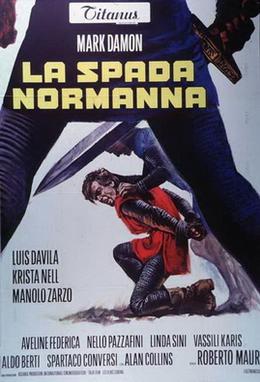
I traced the source of the opening dialogue to the English dubbed version of an Italian film titled La Spada Normanna (dir. Roberto Mauri, 1971). Its English title is Ivanhoe, The Norman Swordsman, or The Norman Swordsman when shown on UK TV.
The film stars the American actor and film producer Mark Damon (1933 – 2024) as Ivanhoe.
Lyrical Themes and Interpretations
Fall science has been unsuccessful in identifying a coherent narrative or theme in the text of “Ivanhoe’s Two Pence”. There is no law that says it has to have one, of course, and Mark E. Smith’s lyrics are often far from straightforward, but it doesn’t hurt to look. It might waste a lot of time, but it doesn’t hurt. But having failed to construct a plausible interpretation of the song as a whole, there are three threads that we can pull at instead, so let’s do that. The first thread is “Ivanhoe”. The second thread is money. The third thread is Shakespeare’s Sonnet 28 (1609).
Ivanwho?
“Ivanhoe”, of course, is the title of a novel by Sir Walter Scott (1771 – 1832), originally published in three volumes in December 1819. See Wikipedia.
Mammon
Sonnet 28
How can I then return in happy plight
That am debarred the benefit of rest?
When day’s oppression is not eased by night,
But day by night and night by day oppressed?
And each, though enemies to either’s reign,
Do in consent shake hands to torture me,
The one by toil, the other to complain
How far I toil, still farther off from thee.
I tell the day to please him, thou art bright,
And dost him grace, when clouds do blot the heaven;
So flatter I the swart-complexioned night,
When sparkling stars twire not thou guil'st the even;
But day doth daily draw my sorrows longer,
And night doth nightly make grief’s length seem stronger.
Footnotes
- This line feels a bit like a corruption and contraction of the third and fourth lines of Shakespeare’s Sonnet 28:
When day’s oppression is not eased by night,
But day by night and night by day oppressed? ↩︎ - This line, repeated albeit with slightly different wording later in the lyric, is borrowed from the first line of William Shakespeare’s Sonnet 28: “How can I then return in happy plight”. ↩︎
- “Mammon” is a term from the New Testament of The Bible, which apparently means money or riches. Sometimes “Mammon” is personified. See Wikipedia. “Ye cannot serve God and mammon”, says Jesus in Matthew 6:24 (King James Version, see Bible Gateway) and Luke 16:13 (King James Version, see Bible Gateway). ↩︎
- The first line of Shakespeare’s Sonnet 28, repeated with slightly different wording. ↩︎
- The second line of William Shakespeare’s Sonnet 28: “That am debarred the benefit of rest”. ↩︎
- Standing cups are medieval drinking vessels with various ceremonial and other associations. See Wenham (1947). ↩︎
Sources / Links
- The Annotated Fall: “Ivanhoe’s Two Pence” [Archived]
- Ford, Simon (2003). Hip Priest: the story of Mark E Smith and The Fall. London: Quartet Books.
- Mackay, Tommy (2018). 40 Odd Years of The Fall. Place of publication unknown: Greg Moodie.
- Pringle, Steve (2022). You Must Get Them All: The Fall on Record. [paperback edition]. Pontefract: Route Publishing Ltd. [Online store]
- Shakespeare, William (1609). “Sonnet 28.” in Shakespeare’s Sonnets. Text available online via Folger Shakespeare Library [Online]. 1609 facsimile page image available online via Internet Shakespeare Editions [Online]
- Smith, Mark E. (2008). vII. The Lough Press & AMarquisManipulationProductions. [AKA the Blue Lyrics Book]
- Sound:Mind (2015). “Steve Hanley (The Fall).” Podcast episode posted to Soundcloud, 16 March 2015. [Archived record of podcast – note the episode is no longer available]
- The Track Record: “Ivanhoe’s Two Pence”
- Wenham, Edward (1947). “Flashback: English Standing Cups”. Originally published in American Collector, reprinted by Collectors Weekly, blog post dated 16 April 2009. [Available online] [Archived]
- Wikipedia: Ivanhoe
- Wikipedia: Ivanhoe, The Norman Swordsman
- Wikipedia: Sonnet 28 (Shakespeare)