

Lyrics
Spiders know these things
Gremlins know these things

Tap, tap, tap, tap
You think it's the pipes
But who turns on the lights?

Our city hobgoblins
Our city hobgoblins

Ubu le Roi is a home hobgoblin 1
And at nights all ready

Our city hobgoblins
Our city hobgoblins

Infest my home at night
They are not alright
Ten times my age
One tenth my height

Our city hobgoblins
Our city hobgoblins

Buzz of the all-night mill
Ah but evil
Émigrés from old green glades 2
Pretentious, eh?

Our city hobgoblins
Our city hobgoblins

They'll get yer
So Queen Victoria is a large black slug in Piccadilly, Manchester 3

Our city hobgoblins

And they say, we cannot walk the floor at night in peace

At night in peace
At night in peace
At night in peace
At night in peace
At night in peace
At night in peace
At night in peace
At night in peace
At night in peace
At night in peace
Commentary
< Post in progress >
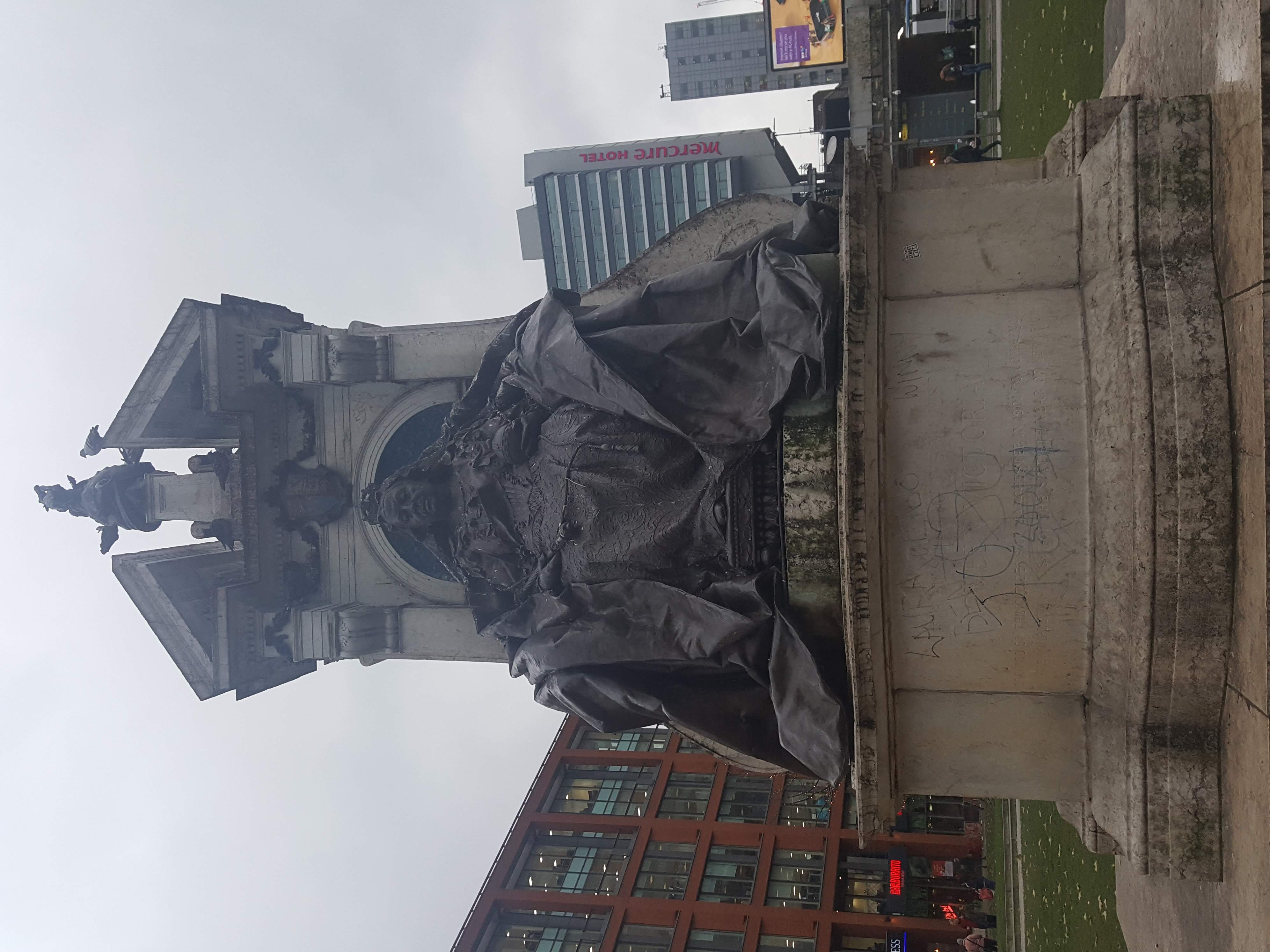
[Google Street View]
Credit for terrible photo: dannyno (November 2018)
“City Hobgoblins” first appeared as the B-side to the “How I Wrote Elastic Man” 7″ single, released 11 July 1980. It was recorded at Cargo Studios, Rochdale, on 8 May 1980 and co-produced by Mayo Thompson, Geoff Travis and The Fall. The song is credited to Steve Hanley, Marc Riley, Craig Scanlon and Mark E. Smith.
In the book Pan (2001), by Camden Joy and Colin B. Morton, a character called Alvin Snook constructs a mad theory about what Mark E. Smith ate before writing songs (a parody of obsessional Fall-fandom)
“Note how, accented in the title, comes the word ‘hob,’ as in ‘HOBNOB,’ a popular brand of biscuit in the United Kingdom. Perhaps this is Mark E Smith’s biscuit of choice; again, I reiterate, there are many theories. ‘Nob,’ the biscuit’s lost syllable, is, significantly, British slang for ‘penis.’ ‘Goblin,’ of course, is how ‘gobbling’ would sound if pronounced by a working-class prole of Mark E Smith’s ilk. I can therefore argue with resolute certainty that ‘City Hobgoblins’ is about oral sex.”
Joy and Morton, 2001.
Snook and his theory are satirical (and, of course, targeted at projects like this one) but I cannot resist taking the bait. There has never been any good reason to think that there’s a connection between “City Hobgoblins” and McVitie’s Hobnob oat biscuits, and one extremely good reason for dismissing the idea completely, which is that Hobnobs did not exist in 1980. The brand was launched in 1984 (some sources say 1985, but I have found newspaper advertisements from 1984).
Footnotes
.jpg)
- A nod towards Alfred Jarry’s play, Ubu Roi (1896). “Ubu Roi” is French and translates as “King Ubu” or “Ubu the King”. The play features a character called “Père Ubu”: the source of the name of David Thomas’ band, Pere Ubu. Why M.E.S. is invoking Jarry’s play remains a puzzle, but there may be a clue in Mayo Thompson‘s role as producer: he was a member of Pere Ubu from 1979 – 1982. Also, on 5 March 1979, BBC 2 broadcast in its Arena arts segment Geoff Dunbar‘s short animated film, Ubu, based on Jarry’s play [IMDb]. An Open University version of Ubu Roi was broadcast in May 1979. ↩︎
- An “émigré” (another French word in the lyric, note) is an emigrant for political or religious reasons: exile or refugee. According to the Shorter Oxford English Dictionary, it was originally applied specifically to those who left France during The Revolution of 1789-1799, but the meaning broadened over time. ↩︎
- A reference to the bronze sculpture of Queen Victoria (1819 – 1901) in Piccadilly Gardens, Manchester. Edward Onslow Ford (1852 – 1901) was commissioned to make the sculpture in 1897 for Victoria’s Diamond Jubilee, but it wasn’t completed until after her death. Originally conceived as a marble sculpture, Victoria herself suggested it be made in bronze instead, due to Manchester’s polluted air. The sculpture was unveiled by Lord Roberts (Field Marshall Frederick Roberts) on 10 October 1901. 1901 was not a lucky year for any of those involved. Queen Victoria died on 22 January 1901 and Edward Onslow Ford died on 23 December 1901. A woman called Fanny Dewhurst was killed during Lord Roberts’ procession through Manchester, when a window-ledge gave way. The sculpture has proved divisive: it has not usually been regarded highly as a work of art. For more information see the entry for the statue on the A Manchester View site and Banerjeee (2012). The statue is Grade II listed (see English Heritage listing page). ↩︎
Sources / Links
- A Manchester View: “Manchester Monuments: Queen Victoria”. (undated) [Archived]
- The Annotated Fall: “City Hobgoblins” [Archived]
- Banerjee, Jacqueline (2012). “Queen Victoria, Piccadilly, Manchester, by Edward Onslow Ford.” The Victorian Web, article last updated 19 May 2012. [Online] [Archived]
- English Heritage. “Queen Victoria Monument”. (undated).
- Ford, Simon (2003). Hip Priest: the story of Mark E Smith and The Fall. London: Quartet Books.
- Mackay, Tommy (2018). 40 Odd Years of The Fall. Place of publication unknown: Greg Moodie.
- Pringle, Steve (2022). You Must Get Them All: The Fall on Record. [paperback edition]. Pontefract: Route Publishing Ltd. [Online store]
- Smith, Mark E. (1985). The Fall Lyrik & Texte Von Mark E. Smith. In Deutsch & Englisch. With Drawings by Brix. Berlin: The Lough Press. [AKA The Orange Book. Available online in The Internet Archive]
- Smith, Mark E. (2008). vII. The Lough Press & AMarquisManipulationProductions. [AKA the Blue Lyrics Book]
- Smith Start, Brix (2016). The Rise, The Fall, and The Rise. London: Faber & Faber. [Text available online in archive.org]
- The Track Record: “City Hobgoblins”
- Wikipedia: Ubu Roi
- Wolstencroft, Simon (2014). You Can Drum But You Can’t Hide: a memoir. Trowbridge: Strata Books. (2nd edition published by Route Publishing, 2017).