I put a block on the words I put a block on the words I put a block on the words I put a block on the words
This I hear on a train This I hear on a train We had salmon on a bus 2 At Epsom no races lost 3 We don't bet we just take We don't bet we just take
I put a block on the words I put a block on the words I put a check on the world I put a block on the words
Listen boys and girls Just closer on the clommererds 4 Just close off the words I put a block on the words
The nine unknown men knew this 5 The nine unknown men knew this Three sorts - the first, along Louie's life 6 The second, the complete restructure of your pretentious life 7 Three, the only reason you know this is that it was well documented 8 But I say
I put a block on the words I put a block on the words I put a block on the words I put a block on the words I put a block on the words I put a block on the words
Here's an independent chart money-spinner 10 For all you people who've come a long way Me and the guys played this for charity for spastics 11 We did it ten thousand times and raised five shillings and seven and a half pence for charity 12
Cary Grant's wedding 13 Hail new puritan, righteous maelstrom 14 Have you ever heard a Bill Haley LP? 15
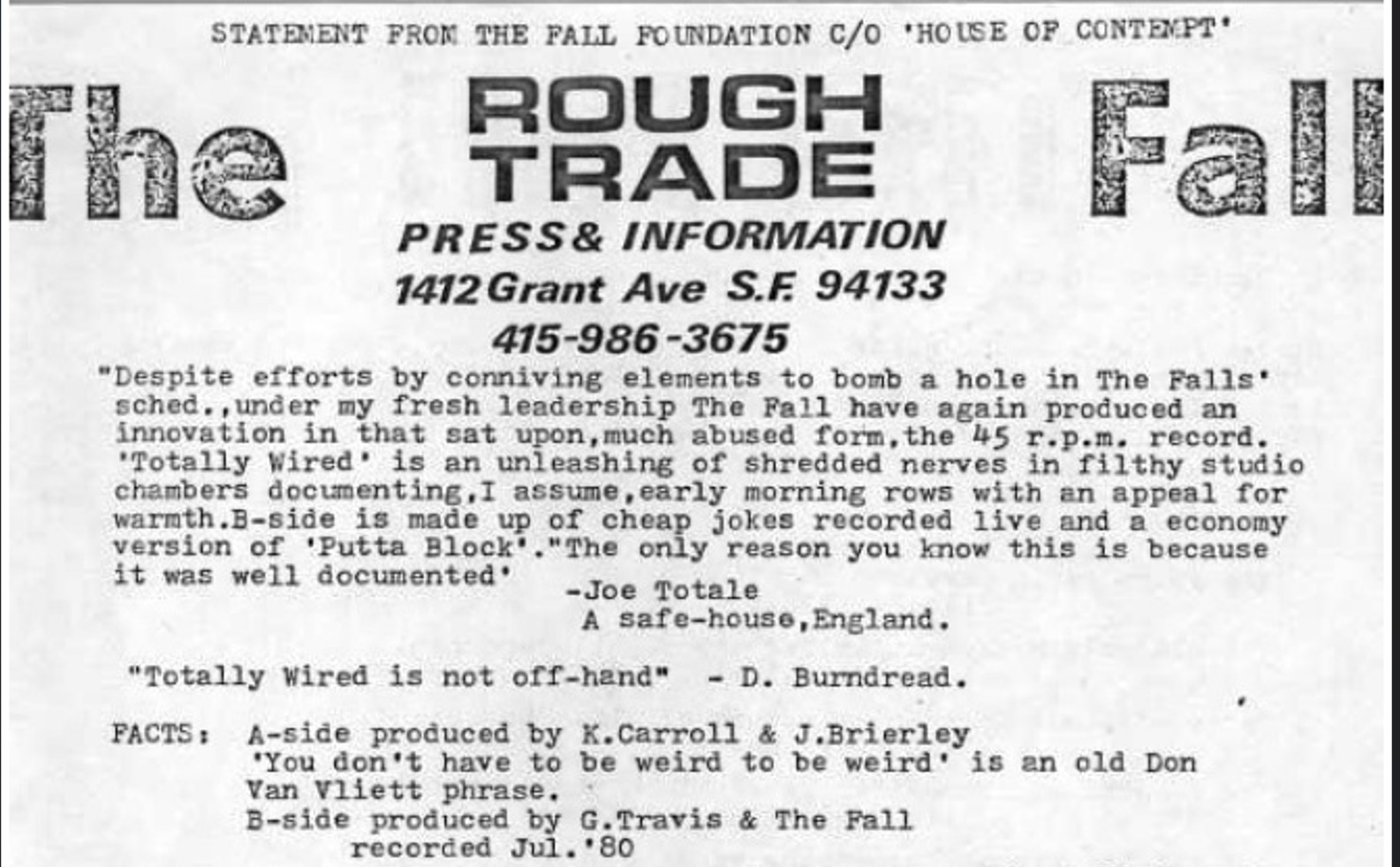
“B-side is made up of cheap jokes recorded live and a economy version of ‘Putta Block’. “The only reason you know this is because it was well documented’.”
Statement from The Fall Foundation, c/o ‘House of Contempt’. Rough Trade press release for “Totally Wired” single.
“Putta Block” first appeared on record as the b-side of the “Totally Wired” single (released September 1980). For some reason, “Putta Block” itself is sandwiched between excerpts of The Fall live. The track was recorded in July 1980 and produced by Rough Trade‘s Geoff Travis and The Fall.
Originally credited (on the single) to “Riley / Scanlan [sic] / Hanley / Smith”, when “Putta Block” was included as a bonus track on the Castle/Sanctuary expanded reissue of Grotesque (After the Gramme) (CRMCD883, 2004) both Hanleys were credited: “Smith, Scanlon, Riley, Hanley, Hanley”. The same credits were given when it was compiled on the Cherry Red box set The Singles, 1978-2016 (CRCDBOX30, 2017): “Scanlon/Riley/Smith/Hanley, S/Hanley, P”. Note that the transcription above is based on the single version, which version can only be heard on the original 7″: for some reason, every time the track has been compiled subsequently, it is cut after “Every-” in the penultimate live “Everybody goes Cary Grant’s wedding” line.
“Totally Wired” was widely reviewed – not particularly positively – in the music press, but “Putta Block” went unmentioned (I have checked the reviews in Melody Maker, New Musical Express, Record Mirror, and Sounds). It hasn’t had a lot of attention; even Simon Ford ignores it when discussing “Totally Wired”. Tommy Mackay describes it as “a hastily assembled track flung out there at the last minute. There’s nothing wrong with this. The actual song itself is no bad and not a little baffling.” (2018, p.38). For Steve Pringle it’s simply an “oddity” (2022, p.71). Both writers note the live content: “Mish mash of other live bits, allegedly out takes from Totale’s Turns, mixed in with this, including The NWRA, Rowche Rumble and Cary Grant’s Wedding…” (Mackay); “nearly a minute and a half of a live recording of ‘The N.W.R.A.’ is abruptly interrupted by an original song… It finishes with clumsily edited live clips of ‘Rowche Rumble’ and ‘Cary Grant’s Wedding’.” (Pringle).
There are only two well documented live performances of “Putta Block”: the Beach Club, Manchester, on 28 May 1980, and the Marquee, London, on 24 July 1980. However, there are number of gigs during the period for which recordings and/or setlists are not available, so it is possible that the song was played on more than those two occasions.
What does it mean to “put a block on the words”? Whose words? Is M.E.S. confessing to writer’s block, or singing about refusing to have lyric sheets on The Fall’s records? At the original annotatedfalldoomby.com, bzfgt interpreted the song as “a statement of intent… MES aims to write in such a way as to thwart easy comprehension of his lyrics, the gamble being that the possibilities of interpretation will thereby be enriched.” Which is as good an interpretation as any, but it’s tough to find much in the actual lyric to support it. Which, of course, could be the point.
Footnotes
The track begins with an extract from a live performance of “The N.W.R.A.” and what is apparently M.E.S.’s opening on-stage comment. It isn’t known where the recording comes from. ↩︎
A much-debated lyric. The previous line, “This I hear on a train”, suggests that the song’s narrator is reporting this line as something he overheard, but it’s not necessarily so. ↩︎
“Epsom” refers to the racecourse at Epsom Downs (see Wikipedia). Specifically it’s likely a reference to the annual Derby Stakes, aka the Epsom Derby, or just “The Derby”, which is the most famous race to be hosted there (see Wikipedia). ↩︎
Nobody seems to know what “clommererds” are. It’s likely we are mishearing the word. ↩︎
The Nine Unknown is a novel by Talbot Munday, first published in 1923. However, Louis Pauwels and Jacques Bergier’s classic of occult history (i.e. made up but entertaining nonsense), The Morning of the Magicians has a whole section on the “nine unknown men”. This, rather than Munday’s book, is most likely MES’ reference here. Whether Pauwels and Bergier were inspired by Munday is unknown. ↩︎
Louie or Louis? Louie Armstrong? Louis XIV of France? Napoleon III? Louis Pauwels (co-author of The Morning of the Magicians)? ↩︎
M.E.S. echoed this line many years later in the lyrics of “Sons of Temperance“: “… the reconstruction of your new life” and “… the restructure of your new life.” ↩︎
A line also used in Mark E. Smith’s “self-interview” from 1980 (originally put out on a Fuck Off Records tapezine. An excerpt was appended to the Backdrop compilation, but it was subsequently included in full on the Castle/Sanctuary Grotesque reissue (CRMCD883, 2004)). ↩︎
The track now switches back to excerpts from live performances. These final lines are not heard in either of the two circulating live versions of the song. The “independent chart/charity” lines seem to come from a performance of “Rowche Rumble” (provenance unknown), before the track jumps into a live extract from “Cary Grant’s Wedding“. ↩︎
The UK’s “official” independent music chart debuted in Record Week, 19 January 1980. An “independent” record was defined as one that was distributed by a company not owned by one of the big record labels at the time: i.e. CBS, EMI, MCA, PolyGram, RCA and WEA. The concept of “independent distribution” would give the ‘majors’ a way of getting their singles into the indie charts – they would set up and fund a label that was independently distributed. See Copsey (2020); see also Lazell (1997). ↩︎
The use of the word “shillings” here is anachronistic, since Britain has been using decimal currency since 1971. There were 20 shillings to the pound, and 12 old pence to the shilling. Decimalisation simplified this by abolishing the shilling and defining the pound as worth 100 new pence instead of 240 old pence. ↩︎
Bill Haley (1925 – 1981) popularised rock and roll in the 1950s with the group “Bill Haley and His Comets”. Many of his hits are among the best known songs, or versions of songs, of the genre, but I suspect Mark E. Smith would have regarded him as a watering down of r’n’r’. Having said that, I’ve not found any comments to that effect. ↩︎
As noted in the commentary I am following the original uncut single version here. Every time the track has been compiled subsequently, it is sharply curtailed after M.E.S. enunciates the first “Every-“. ↩︎