

Lyrics
Say! Mmmmmm-uuuaahhh
Say! Mmmmmm-uuuaahhh
Say! Mmmmmm-uuuaahhh

Monday night at operation control
I sat facing rows of monitor mountains 1
Mind control
Life control
Operation mind control 2

My first is in car 3
I'm easily bought, but still always short 4

Fly that over space beam

And round my way the people still do say
Riddler
Riddler
And round these parts the people still impart
Riddler!

My second is in ... 5

Zoooooooom!

Say! Mmmmmm
Say! Mmmmmm

And round my way the people still do say
Riddler
Round these parts the people still impart
Riddler
Riddler

Third - slopes 6
Fourth - inverting within 7

Round my way the people still do say
Riddler
And round these parts the people still exclaim
Riddler
And even now kids round our place say
Riddler
Riddler
Commentary
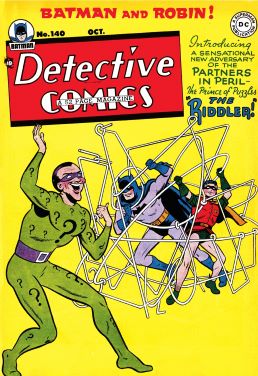
The first appearance of the Riddler.
Cover of Detective Comics #140 (October 1948). Art by Win Mortimer.
“My approach to writing has definitely changed. I used to get into the serious thing of loads of words, couldn’t get enough into a song. You end up dead pretentious.
“That’s what I like about ‘Riddler’, it’s dead slow and there’s not a lot said in it but it sort of stops people in their tracks. I always remember we used to shout ‘Riddler’ when we were kids in Salford, but I can’t remember what for, it’s still a sort of mystery.”
Mark E. Smith, interviewed by Gavin Martin in the New Musical Express, 30 August 1986, p.12. [Note that Mark E. Smith was born and grew up in Prestwich, not Salford. Although I suppose that wouldn’t prevent him from shouting “Riddler” in Salford!]
“I always get people coming up with these bizarre theories about the songs. Fantastic.
I got it a lot with ‘Riddler!’ off the last album, which everyone thought was about ‘Batman’. It came from when I was young, when we used to shout words at the old fellas in the street. ‘Riddler!’ Just to see them jump. That was even before ‘Batman’. We’d shout other things as well. ‘Wanker!’ Stuff like that. ‘Grandmother!’ You never think why you do these things as a kid. Sometimes we’d shout, ‘Stop lepping, lepping on the door, lepping on the door,’ and run away.
“Just to confuse and startle these old blokes. Everybody’s guilty of something, really.”
Mark E. Smith, interviewed by Jonh Wilde in Melody Maker, 5 March 1988, p.38.
Note that M.E.S. was born on 5 March 1957 and that Batman, created by Bill Finger and Bob Kane, debuted in Detective Comics #27, cover-date May 1939 (published 30 March). The villainous Riddler debuted in Detective Comics #140, dated October 1948. So it is obviously not true that when the young Smith was shouting “Riddler!” at old men in the street, this was pre-Batman, or pre-Riddler. Perhaps M.E.S. means the comedy-camp Batman TV series, starring Adam West and Burt Ward, which was first broadcast in 1966. There was a film version, which was effectively a trailer for the TV series, the same year.
“Riddler!”, credited to Mark E. Smith, Brix Smith and Simon Rogers, was first released on Bend Sinister (1986). The studio version used on the album is the only version to have been officially released. When recorded, the group consisted of Paul Hanley (drums), Steve Hanley (bass), Simon Rogers (keyboards, guitar), Craig Scanlon (guitar), Brix Smith (guitar, keyboards, vocals) and Mark E. Smith (vocals).
During a performance of “Words of Expectation” at Laser’s, Haringey, London, on 10 February 1986, M.E.S. improvised the words, “Riddler! Riddler! Riddler! Riddler!” An early glimpse of the idea for this song?
Bend Sinister was released on 29 September 1986, but “Riddler!” had been debuted live (so far as we know) at the first UK gig after that year’s American tour, at Lea’s Cliff Hall, Folkestone, on 5 June. Bend Sinister was recorded mid-1986, and the debut performance is not very different from the album version.
The song was played at the majority of (documented) gigs until February 1987. The record suggests it was retired after the gig at Hunky Dory, Detmold, Germany, on 19 February.
According to Brix, the song is a tribute to the Batman villain. She says they had an action figure of the Riddler, but the evidence is otherwise (see below). M.E.S., however, says the origins of the song go back to his childhood. If that’s not misdirection, it fits with his interest – indulged from time to time – in word-less, or meaningless, vocals. Of course, it could be both. And there is, in any case, more to the song than either Brix or M.E.S. are letting on. The opening lines of the lyric mention mind control. We also have a collage of riddle/crossword tropes, suggesting a puzzle outside the text which we are shown only in scrambled fragments. The elements may not even come from the same puzzle. Lacking meaningful parameters, and with essential parts of the clues omitted, no coherent solution is viable. Perhaps, to return to the Riddler character, that is the ultimate villainy!
Live versions of the song seem to have omitted most of the riddle/crossword fragments. But many performances included a superficially complete, but still insoluble, version of the first riddle – see Footnotes.
John Leckie, who produced Bend Sinister, seems to have been baffled by the track:
“Not much happens in it. I couldn’t make head nor tail of it. Some you have your fantasy of what they’re about but not that one.
John Leckie, quoted in the accompanying booklet to the 2019 Beggars Banquet Bend Sinister reissue. p.15.
Brix, on the other hand, loved it:
“I love Riddler!. In LA, one of my best friends lived next door to a guy who produced Batman. And the guy who played the Riddler lived down the street from her. I was super obsessed with all of this as Batman was my childhood thing. I got a Jean Paul Gaultier t-shirt that had a question mark on it, just like the Riddler. Mark used to borrow that all the time – I remember writing the riff of Riddler and it being really dark – Mark called it Riddler! We used to have a Riddler doll, a little plastic model of it in our house. Listening to it again, it’s one if [sic] my favourite tracks on the album.”
Brix Smith Start, quoted in the accompanying booklet to the 2019 Beggars Banquet Bend Sinister reissue. p.15. I presume the production she refers to is the 1960s TV series. Although Brix liked “Riddler!”, she wrote in her autobiography that the experience of recording Bend Sinister was “miserable” (Smith Start, 2016, p.223).
Of the reviewers of the album back in 1986 (‘Albert Camus’ Pet Hog’, 1986, p.20; Barron, 1986, p.31; Denselow, 1986, p.17; Haslam, 1986, p.37; Reynolds, 1986, p.31), only Jack Barron in Sounds even mentioned “Riddler!”, but the song now seems to be well-regarded. Dave Thompson describes it as “deliciously dense and atmospheric” (2003, p.90), and Tommy Mackay sums it up as simply “Magnificent… a real spine tingler.” He thinks it is “underrated” (2018, p.86). Steve Pringle thinks it a “curious little number” with an “obvious slow-fast dynamic”, but “it sustains its six minutes without issue, perhaps because of the range of intriguingly ominous noises lurking in the background.” (2022, pp.182-183).
Mastered from Cassette?
According to a oft-repeated legend, Bend Sinister was mastered from a cassette tape (see Ford, 2003, p.159; Pringle, 2022, p.178). John Leckie, the producer, seems to have been the origin of the story:
“When we were mastering ‘Bend Sinister’ and the guy had just cut the acetate, Mark was stomping around saying, “That’s not the mixes we had in the studio,” but he’d been listening to a chrome Dolby cassette he’s taken away and played on his little Walkman through a speaker that was distorting, and that was his reference. In the end, a lot of that album was cut from a cassette because that was the quality that Mark wanted. He was actually right, though, because that’s their sound.”
John Leckie, interviewed by T. Doyle in Melody Maker, 3 June 1995, p.53. Note the quotation given in Ford, 2003, seems to have been slightly wrongly transcribed, though it doesn’t change the meaning).
Over time, Leckie’s original account was watered down. In 2019, the booklet accompanying the reissue of Bend Sinister we were told it wasn’t the whole album, just a couple of tracks:
“I don’t remember the whole album being mastered off of a cassette – [It was Riddler! and Terry Waite Sez]…”
“… Riddler! is actually mastered from cassette. I think it’s gone down in history that the whole album was.”
John Leckie, quoted in the accompanying booklet to the 2019 Beggars Banquet Bend Sinister reissue. p.15. Note that the information in square brackets seems to be an editorial intervention, rather than Leckie speaking. As you can see, he goes on to cite only “Riddler!”
Then also in 2019, in conversation with Brix, Leckie said that he thought only this track was mastered from cassette. He also comments that there is “a lot missing” from the track, but I don’t know if he means lyrically or in terms of sound (Smith Start, 2019).
This was confirmed in 2021, in comments made by Leckie and Steve Hanley during the Tim’sTwitterListeningParty devoted to Bend Sinister:
“Riddler!
Recorded Abbey Road straight to stereo but mastered from cassette tape. Bit of hiss but strong tone and vibe!
Wild guitars ! Wild drums! Watch out!”
John Leckie (@JohnLeckie7), posted to Twitter, 10 November 2021, 8:25 PM. [Link to X]
“Riddler.
This song started the rumours the album was mastered from a cassette tape. Just this song folks.”
Steve Hanley (@Stephenhanley6) posted to Twitter, 10 November 2021, 8:25 PM. [Link to X]
Riddler/Joker Mix-Up
Take a look at the booklet artwork for Bend Sinister. Note the image labelled “9”, intended to illustrated the ninth track, i.e. “Riddler”.
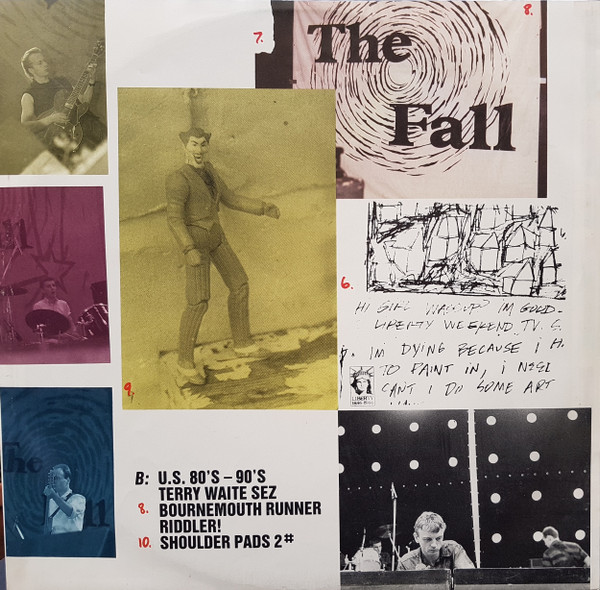
During the Tim’s Listening Party devoted to Bend Sinister on Twitter on 10th November 2021, Brix (@Brixsmithstart) said:
“Mark loved the RIDDLER from the Batman comics and TV show. We shared a black T-shirt with a big white ? On it. We also had a doll of the Riddler we took on the tour bus with us. This song is paying homage to that character.”
Posted by brixsmithofficial (@Brixsmithstart) to Twitter during a Tim’s Twitter Listening Party devoted to Bend Sinister. 10 November 2021, 8:27 pm. [Direct link]
She followed up with:
“When we took that plastic Riddler action figure on tour, we used to torture it in every way we could. On the bus, we made a noose and hung it. We burnt its ass with matches and lighters. And we drowned it in beer and vodka most nights.”
Posted by brixsmithofficial (@Brixsmithstart) to Twitter during a Tim’s Twitter Listening Party devoted to Bend Sinister. 10 November 2021, 8:29 pm. [Direct link]
The thing is, if the plastic action figure pictured in the Bend Sinister artwork is the same plastic action figure as the one that Brix is talking about (and it looks in good condition – pre-tour?)…
…it’s not actually the Riddler.
It’s the Joker.
I’ve got one:
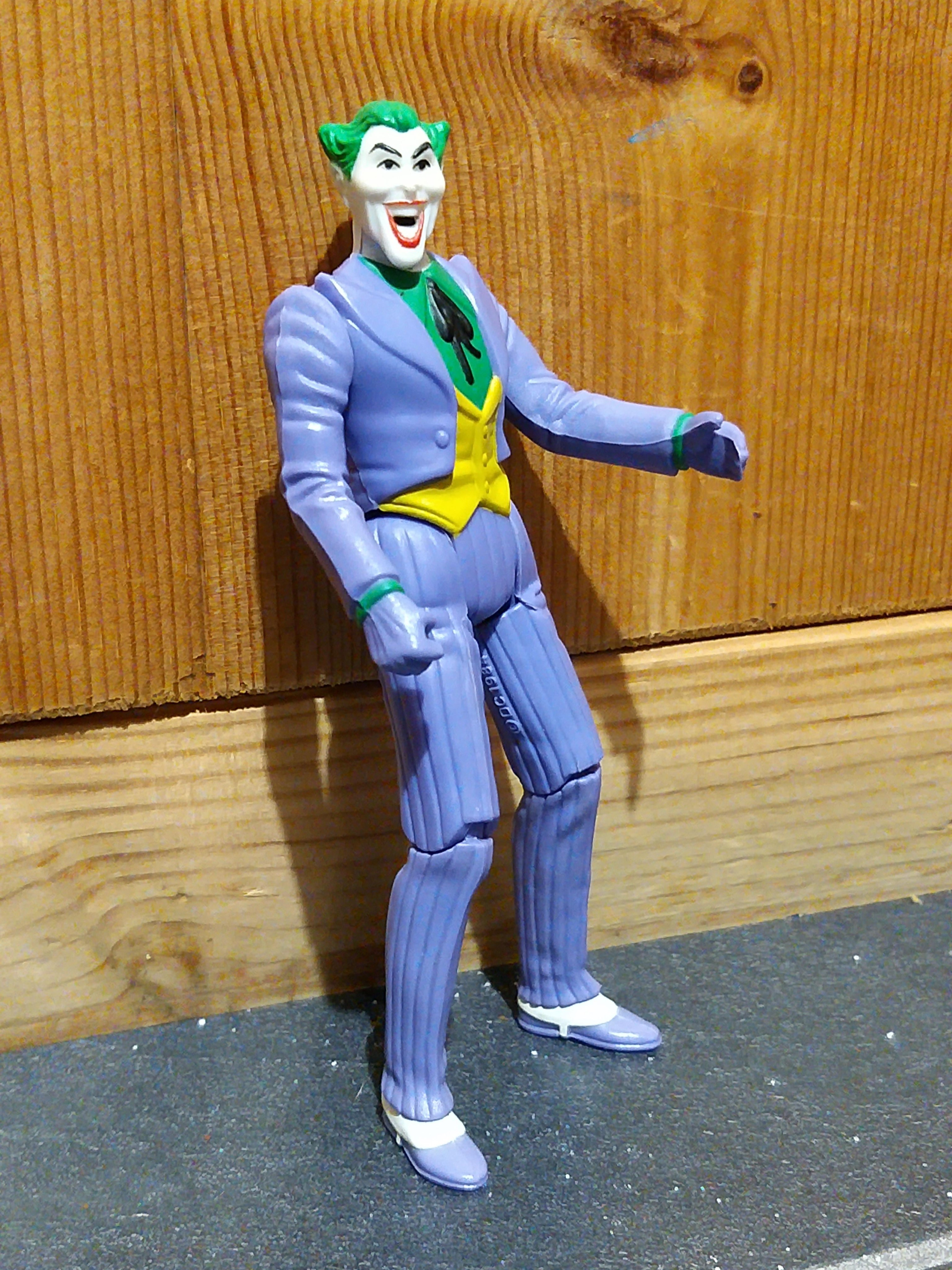
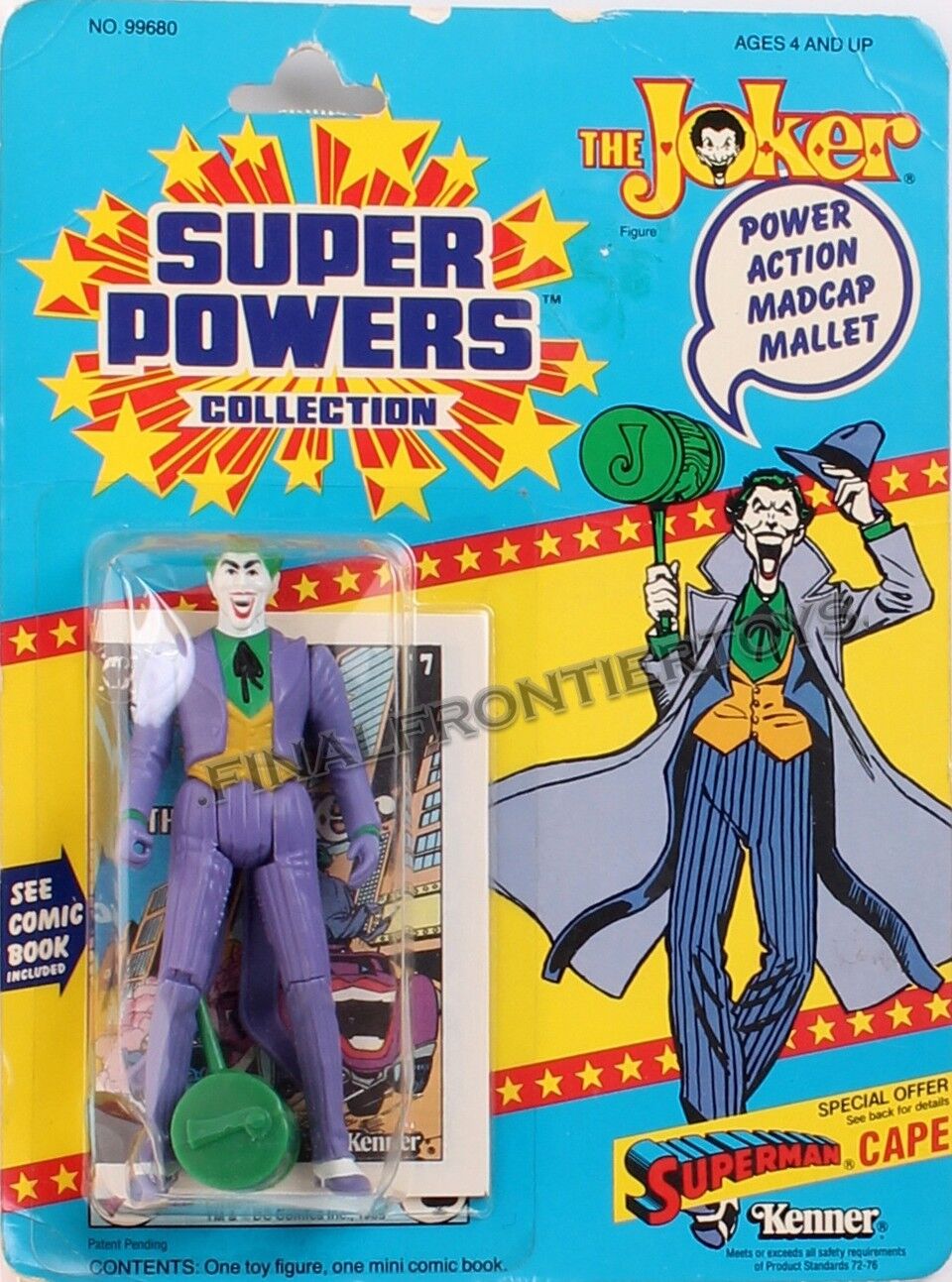
See also: actionfigureinsider.com
Footnotes
- Two ways to think about this line. Either the image is of a mountain of rows of CCTV screens, or of rows of vital signs monitors displaying up-and-down waveforms/traces, which look like a bit like mountain ranges. In the former case, is the narrator a security guard or surveillance operative? In the latter case, someone with a medical or psychiatric function? ↩︎
- According to Mark E. Smith, quoted in Option magazine in 1986:
“I read a great book called Mind Control and the conclusion of the book was good, it was saying there’s no real threat, people think the threat in society is from right wing or left wing, it’s not the case. The threat is a loss of individuality, a loss of basic intelligence, that’s the danger approaching society, it has nothing to do with Reaganism or communism; those are both redundant sort of things. They really are redundant.” (Brecker, 1986, p.29).
There are quite a few books with similar titles, for example: Mind Control, by Peter Schrag (various editions, e.g. New York: Pantheon Books, 1978 / London: Marion Boyars, 1980), and Mind Control, by Melvin Berger (New York: Thomas Y. Crowell, 1985). But the book M.E.S. is talking about (based on his description of the contents) can only be Operation Mind Control: The CIA’s Plot Against America, by Walter Bowart (New York: Dell, 1978 / London: Fontana, 1978).
Bowart (1939 – 2007) was a ‘counter-cultural’ journalist, an associate of Timothy Leary, and one of the founders of East Village Other, a New York-based underground newspaper. It lasted from 1965 – 1972, but Bowart departed for Tucson, Arizona, in 1968.
Some quotations from Bowart:
“There seems to be a good deal of cultural momentum leading toward a cybernetic anthill society. If we can draw any inference from the numerous predictions made by men of accomplishment in our society, it is that direct brain-computer interface, the cyborg, and the resulting mass mind control are on the horizon.” (p.270).
“In the past such people as Hitler, Lenin, or Mao Tse-Tung were high-profile father figures who inspired trust and surrender by the masses. In the modern technological miasma, a nameless, faceless cryptocracy is manipulating world politics.” (p.272).
“As the psychologist Erich Fromm said, “A specter is stalking in our midst whom only a few see with clarity. It is not the old ghost of communism or fascism. It is a new specter: a completely mechanized society, devoted to maximal material output and consumption, directed by computers; and in this social process, man himself is being transformed into a part of the total machine, well fed and entertained, yet passive, unalive, and with little feeling.” (p.272). ↩︎ - “My first is in car” could mean one of the letters “C”, “A”, or “R”. This looks like half the traditional riddle formula, “My first is in X, but not in Y”. X and Y would likely be thematically linked words and the challenge of the puzzle is to select the correct letter, taking into account the other lines of the riddle, to build a solution word.
Many live versions of the song include an apparently complete variation on this line: “My first is in car, and also in rack”. But this is still not very illuminating, because the “answer” could still be “C” or “A” or “R”! ↩︎ - This looks more like a legitimately constructed riddle, though not of the same form as “my first is in car”. If so, an unproveable but plausible answer is “time” – you can buy time but always be short of time. However “easily bought” could mean “susceptible to bribery” and “always short” could mean in stature, or short of money, or ephemeral/transient. Or the solution might be a synonym for “easily bought” (“venal”, “corrupt”, “crooked”, “dishonest”, “mercenary”… and so on), which we are then instructed to truncate. ↩︎
- A second fragment of a riddle. But unless the next line, “Zoooooooom!”, is part of the clue, it’s impossible to do anything with it. ↩︎
- A third fragment of a riddle. You’d expect it to go something like, “my third is in slopes, but not in hills”, or something. “Slopes” calls back to “mountains” in the first few lines of the song, so maybe it’s “my third is in slopes, but not in mountains.” But it might equally be “ski” or “gradient” or “tilt” or thousands of other words. Since all we have is the noun, it’s a dead end. ↩︎
- The fourth and it seems final puzzle fragment. Actually, “inverting within” has less of the appearance of a riddle, or part of a riddle, and more of the structure of a cryptic crossword clue. “Inverting within” could well be a detached piece of crossword jargon: the instruction is to take some letters hidden within another word or phrase, and then reverse them to get the answer. But “within” what? We don’t seem to have the word or phrase that the clue is pointing us to, so to all intents and purposes it cannot be solved. “Within” is not a meaningfully reversable word. Inverting it might turn “within” into “without”, but that doesn’t help much. ↩︎
Sources / Links
- Albert Camus’ Pet Hog (1986). “The Fall: Bend Sinister”. Record Mirror, 4 October. p.20.
- The Annotated Fall: “Riddler” [Archived]
- Barron, Jack (1986). “Curly Wurlies.” Sounds, 4 October. p.31.
- Bend Sinister (1986). “Riddler!” in booklet. Beggars Banquet, reissue, 2019: BBQ2153CD, 2xCD. pp.19-20.
- Bowart, Walter (1978). Operation Mind Control: The CIA’s Plot Against America. New York: Dell. [Text available online in archive.org]
- Brecker, Scott (1986). “Wordsmith”. Option, July/August. pp.26-29.
- Denselow, Robin (1986). “Lifting the muffling curtain: Rock/Pop”. The Guardian, 17 October. p.17.
- Doyle, T. (1995). “Control Zone: A Desk Job with John Leckie.” Melody Maker, 3 June. pp.51-53.
- Ford, Simon (2003). Hip Priest: the story of Mark E Smith and The Fall. London: Quartet Books.
- Haslam, Dave (1986). “Mind Rocker: The Fall, Bend Sinister.” New Musical Express, 4 October. p.37.
- Mackay, Tommy (2018). 40 Odd Years of The Fall. Place of publication unknown: Greg Moodie.
- Martin, Gavin (1986). “Revolting Soul.” New Musical Express, 30 August. pp.10-13. [Page images and text available online via thefall.org]
- Pringle, Steve (2022). You Must Get Them All: The Fall on Record. [paperback edition]. Pontefract: Route Publishing Ltd. [Online store]
- Reynolds, Simon (!986). “Fall Guise: The Fall, Bend Sinister”. Melody Maker, 4 October. p.31.
- Smith Start, Brix (2019). “The Brix Show + Special Guest John Leckie.” Boogaloo Radio. Uploaded 2 January. [Available on Mixcloud]
- Smith Start, Brix (2016). The Rise, The Fall, and The Rise. London: Faber & Faber. [Text available online in archive.org]
- Thompson, Dave (2003). A User’s Guide to the Fall. London: Helter-Skelter Publishing.
- The Track Record: “Riddler”
- Wikipedia: Walter Bowart
- Wilde, Jonh (1988). “The Mouth that Roared”. Melody Maker, 5 March, pp.36-38.