

Lyrics
At night though I do not sleep
I dream of the park up the road 1
I open the bushes, a couple of lovers
Trying to be lust rockers 2
And although my spouse is in the other room
I think we can do it here
Yes, and she makes me pay
For every girl I have the guts to look at
Anyway here, quiet here, quiet here

You thought it'd be great
You thought it'd be great
But a good mind does not a good fuck make

I take you to the park up the road
But here is the rain
Rain makes policemen no threat
Turns cars into little specks
Muffles the shouts of your neighbour
And we will have sex here
Here, here
Couch, shagged out

There's no hard-ons 3
It's just come and it's gone 4

I'm becoming everything I used to hate
But I can't go back there
Not back there, I can't go back there
Not back to the park
The brown monk ghost will catch us 5
And make us lust rockers
Make us wear huckleberry masks and, uh, huckleberry masks 6
You're saying you don't believe in kobolds 7
But I can't believe that
Especially the crap about the huckleberry masks
Commentary
“I went through a period of seeing ghosts when I was about 18, 19.”
Mark E. Smith, interviewed by Mark Sinker in The Wire, August 1986. p.21.
“The older I get, the more I remember things [my dad] used to say to me, things like, ‘If you’re feeling too sexy have a glass of water and a run round the backyard.”
Mark E. Smith, Renegade, pp.173-174 (2009 paperback edition).
“In The Park” was first released on the album Grotesque (After the Gramme) (recorded mid-1980, released 17 November 1980). It is credited to Mark E. Smith alone. The group at the time of recording were Paul Hanley, Steve Hanley, Marc Riley, Craig Scanlon, and Mark E. Smith.
There are only four documented live performances of “In The Park”, all of them between July and December 1980. It’s likely that the song was played more often than that, but there are gaps in the record: very few setlists have survived and a significant proportion of gigs during the period were not taped (at any rate the tapes are not in circulation). All of the known performances are available as bootleg recordings, but only one of them has received an official release.
- 24 July 1980: The Marquee, London
- 27 September 1980: Tatton Community Centre, Chorley
- 2 October 1980: Manchester Polytechnic, Manchester
- 11 December 1980: Acklam Hall, London. Released as Live in London 1980 (Chaos Tapes: LIVE006). Cassette, limited edition of 4000 copies. Reissued on CD with bonus tracks in 2004 by Sanctuary Records (CMRCD1005). Reissued in original form on LP by Earmark in 2005 (EM307LP). Also released on CD as The Legendary Chaos Tape (Scout Releases/Rough Trade, 1996: SAR1005), this version re-released on CD by Voiceprint/Cog Sinister in 1999 (COGVP101CD). [See Discogs]
Reception
“In The Park” is not a straightforward song to make sense of, even if its themes don’t seem obscure. But it deserves more attention than it has had, despite its flaws.
Grotesque was widely reviewed when it came out in 1980, but “In The Park” mainly went unremarked. Graham Lock in New Musical Express reduces the theme of the song to one word: “sex”. Ian Pye’s comment in Melody Maker is: “‘In The Park’… is so crudely recorded it’s hard to imagine why they included it.” And that’s about it.
Subsequent writers have tended to trip up over the song’s sexual content, which is often misread, and failed to notice its complexities. The lyrics might be baffling, but the complexity is there.
Simon Ford, for example, has “In The Park” down as merely “an unromantic look at casual sex in awkward locations” (2003, p.87). Tommy Mackay is in full-on sniggering-at-the-back-of-the-class mode in his entry for the song (2018, p.41). Steve Pringle pays more attention to the music than most have (“a nice mix of Bo Diddley-esque shuffle and Beefheart-ish discordance.”), but gets the subject matter of the lyrics precisely backwards in summarising them as “a paean to dogging”. His characterisation of the song as “absolute filth, and lots of fun” is fair enough as far as it goes, but overlooks the supernatural elements completely (2022, p.76).
Here at The Fall Annotation Laboratories we are committed to a rational and scientific method, so we reject the objective reality of ‘ghosts’. But as a psychological, sociological and literary phenomenon we cannot ignore them, and the experiences that believers have are often deeply meaningful to them.
Phantom Monk as Sexual Nemesis: The Lyrics
There’s little lyrical evolution evident from the few tapes available; it seems that the song was “finished” by the time it debuted live (presumably the studio version had already been recorded). A note on the Fall Online Gigography entry for the gig at Birmingham University on 18 March 1980 says, “There’s some ‘In The Park’ lyrics in ‘No Xmas for John Quays‘” (see The Fall Online Gigography: 1980). The recording isn’t of the best clarity, but although it is hard to make out all the vocals, I can hear “There is no hard-ons” towards the end. There may be more that I cannot hear.
“In The Park” has some memorable lines, but it’s not one of M.E.S.’s best lyrics. I don’t think this is primarily a structural thing, because the song appears to be relatively linear. It’s a bit more complicated than that, as I’ll discuss below, but as far as I can tell it’s not a drastically chopped-up narrative. The problem is that M.E.S.’s use of sexually vivid language floodlights tragi-comic sexual (mis-) adventures (although even that level of subtlety is often missed by listeners), burying the potentially more profound and uncanny theme of desire frustrated by paranormal threat. “Fuck” doesn’t have an occult equivalent.
The song contains elements of both farce and dread, but lacks an effective balance between them. Maybe M.E.S. himself wasn’t decided about how seriously he took the song.
This is a shame, because the subject matter of the song is unusual even at its surface; for The Fall, certainly, but also in rock and pop music generally. There are not many Fall lyrics with such an overtly sexual theme (M.E.S. mentions sex in his lyrics more than you might think, but that’s not the same thing), and vanishingly few rock and pop lyrics about erectile dysfunction, premature ejaculation, or erotic inadequacy generally (a “paean to dogging” this is definitely not!).
If we focus just on songs about ‘impotence’ from a male point of view (so excluding songs like “Stutter” by Elastica), “In The Park” joins the select ranks of Alternative TV’s “Love Lies Limp”, Dead Kennedy’s “Too Drunk To Fuck”, Nick Cave and the Bad Seeds’ “Little Empty Boat”, Art Brut’s “Rusted Guns of Milan”, and Kings of Leon’s “Soft”, and not many others, in undercutting stereotypical macho rock sexual storytelling.
But what really makes the lyric unique, so far as I know, is its ambitious but inconspicuous synthesis of sexual transgression and dysfunction and the supernatural. I can’t think of any other song that explores the nexus between ghosts and haunted spaces and sexual anxiety and neurosis (suggestions welcome!).
So what is going on? Interpretation is more or less a mug’s game, and I usually shy away from it, but it seems important to attempt it here. Deep breath.
First of all, notice that the song is narrated in the present tense and in the first person: an ‘I’ who is apparently the protagonist. The text is addressed to the speaker’s apparent lover, identified only as “you”; we learn nothing else about them.
Also in the lyric is the speaker’s spouse, who we are told punishes – somehow – the speaker’s infidelities.
Then there are the lovers in the bushes at the beginning of the song. Their identity is ambiguous. Are they just a dreamed-up couple, whose shenanigans inspire the protagonist’s own unsuccessful experiments with al fresco sex? Or are they a real couple seen in a psychic or precognitive dream? Might they, indeed, be the speaker and their lover?
Finally, there is the character of the “brown monk ghost”. We learn, towards the end of the song, that the protagonist fears being caught by the ghost. I can quite imagine this would put a chap off his stroke. It could be read as just an excuse, given the unfortunate failure of the previous section of the song. The order of events, however, is unclear. We are told that the protagonist can’t “go back there”. So they have been before. The lyric is still in the present tense, which is strange given that the lyric has just told us, also in the present tense, about sexual failure in the park. So is this a future-present tense? The lyric doesn’t indicate any passage of time.
The narrative seems to be circular. The image of a couple acting like “lust rockers”, with which the lyric begins, recurs towards the end. Being made to act like a “lust rocker” is, apparently, a consequence of being caught by the monk, as is being made to wear huckleberry masks (see footnotes). A surreal fate, and so absurd that it makes me wonder if this is a psychic or psychological punishment exacted by the protagonist’s “spouse”.
Then at the very end of the song, we have a couple of lines about not believing the “crap” about the huckleberry masks. Whose voice is that. There is no indication that it’s not the protagonist still talking, and yet the tone and content seems to contradict the protagonist. Could it be the lover, incredulous at all this nonsense about ghosts and whatnot?
The Heaton Park Prototype
In 1981, Mark E. Smith told Edwin Pouncey (AKA Savage Pencil) about an encounter with a ghost in a local park, which may be the inspiration for at least part of the song:
Before I leave to catch the milk train back to London, Mark tells me a story of how he once confronted the ghost of a friar in the park near where he lives. He told the story very matter of factly without any hint of drama which almost led me to believe this sort of experience happens to him all the time. When I expressed my interest he said he would go down there and check it out again for me sometime and send me a report. Any uneasy feelings I may have had about Mark Smith are non existent now and like Lovecraft’s Dunwich Horror the Prestwich Horror is also the invention of a fantastic mind.
Pouncey, 1981, p.19.
At the 2015 Green Man Festival, Mark E. Smith was interviewed for Mojo magazine. One of the questions was “Have you ever seen a ghost?”
Next question. From James Lowther in Seattle: have you ever seen a ghost?
Quite a few, yeah. But not recently.
Quite a few? When was the last ghost that you saw, and where was it, and what was it doing?
Well, you don’t want to say, you know.
You don’t want to say?
I saw a monk, in Heaton Park. That was before The Stone Roses played there. It was a warning. It was a nice park.
Mark E. Smith, interviewed by Ben Thompson for Mojo, Green Man Festival, Bannau Brycheiniog (Brecon Beacons) National Park, Wales, 22 August 2015. [Footage filmed from the audience available on YouTube, posted by user @ElArranzio, 12 March 2016.] Note that The Stone Roses played Heaton Park in 2012, decades after M.E.S.’s ‘ghost’ experience.
Una Baines told her version of (presumably) the same story to the Bury New Road heritage blog, also identifying Heaton Park:
“Me and Mark saw a ghost in Heaton Park and I’ve never seen one before or since. We used to go there a lot and this particular evening we were near the hall that had lights on it. We were both looking and he said ‘Can you see what I can see?’, grabbed my arm and we just ran to the gates. It was like a monk hovering about two feet from the ground, with a cowl and no face, and we both saw it and described the same thing to each other.”
Una Baines, Bury New Road blog, 2022.
“Sex In The Park”
The title, “In The Park”, seems at a stretch like an echo of a routine by the American actor and ‘blue’ comedian, Redd Foxx (1922 – 1991). Foxx, whose real name was John Elroy Sandford, is best known for playing Fred Sandford in the U.S. sitcom, Sanford and Son (1972 – 1977), which was based on the popular British sitcom, Steptoe and Son (1962 – 1974). Sanford and Son was never aired in the U.K.
Foxx also released dozens of comedy LPs. His 1961 record, Laffarama [Discogs], includes a routine with the title, “Sex In The Park.” It goes like this (I’ve set it out like poetry, because it’s kind of delivered like poetry!):
There was a young couple in the park
In the dark
In the bushes
Together, alone
In the park
In the bushes
By the lagoon
In the bushes together
And in love with each other
In the bushes
And the feller spoke first
The feller said, "Baby, I sure wish I had a flashlight so I could see what I was doing"
She said, "I wish you had a flashlight too, 'cos you've been eating grass fifteen minutes!"
Footnotes
- There is no specific geographical detail in the lyrics, but Una Baines has identified Heaton Park as the place where she and M.E.S. saw a ‘ghost’ (see Commentary, above). Heaton Park is not far from the Kingswood Road flat where Smith and Baines lived together. The flat off Rectory Road where M.E.S. and Kay Carroll subsequently lived is, however, closer to Heaton Park. The Park is located in Prestwich, but was sold to the City of Manchester in 1902. Now, the story M.E.S. told Edwin Pouncey may not have been about the same incident (though it likely is), and the “I” of the song may be a character rather than M.E.S. himself, especially since Smith and Baines were not married and the lyrics refer to a “spouse” (but that might not be meant literally). But it doesn’t seem unreasonable to locate the events of the song in Prestwich, even if they are fictionalised. ↩︎
- The phrase “lust rockers” sounds like it’s been borrowed from a tabloid newspaper headline. ↩︎
- I bet there aren’t, what with all these distractions. ↩︎
- The pun is excruciating. ↩︎
- Britain is knee-deep in ghost stories involving monks wearing brown habits, but as far as I have been able to discover M.E.S. and Una Baines are the only people to have reported seeing an apparition of a monk/friar in Heaton Park. According to Johnson (2026), who unfortunately doesn’t cite her sources, ‘ghosts’ associated with Heaton Park include: “Alice”, who mainly haunts the Heaton Hall Orangery but also does a bit of wandering through the park; The Mourning Lady; a ‘confused soldier’; and a ‘black carriage’, lacking driver, horses or passengers. Various websites record the claim there are at least a dozen such stories, though I was unable to find a full list. In any case, none of the stories I’ve found involve a monk or friar. Nothing of relevance appears in Underwood (1978). The official line is that “there are no reports of any ghostly activity in Heaton Hall.”
There was a suggestion at the doomby.com Annotated Fall that the ghost could be identified as “Old Tom”, who supposedly haunts the cellar of Prestwich’s oldest pub, The Church Inn. He is sometimes described as a monk (see Bury New Road blog, 2023; Marshall, 2020). This was widely accepted as the likely reference for long time, including by me. But revisiting the subject for this site, I haven’t found any descriptions of what “Old Tom” is supposed to look like, or indeed any documented accounts at all by anyone who claims to have seen him. And anyway, why would someone headed to a park be worried about a ghostly monk who haunts a pub cellar? We can rule out “Old Tom”, and the Heaton Park monk story obviously fits better. ↩︎ - According to the Shorter Oxford English Dictionary, a “huckleberry” is English dialect for the bilberry (Vaccinium myrtillus), which also goes under the names “hurtleberry” and “whortleberry”. From this derives North American usage for various related plants and their berries (see Wikipedia). Interestingly, the literary evidence of the English usage appears to date from a few centuries later than the literary evidence for the North American usage, but the Shorter holds that it is still likely to be the original usage.
It’s worth thinking about the meaning of masks in general. They are used to hide identity, to hide deformity of the face, or to enable someone to play a role or pretend to be someone else. Masks are used for disguise, protection, performance or entertainment [Wikipedia]. Masks occur in other Fall songs: “Mask Search“, “Insult Song“, “Pittsville Direkt“. There’s also “Masquerade“.
What is a “huckleberry mask”, specifically? Smith never explained, so we don’t exactly know, but suggestions with varying degrees of plausibility have been put forward.
Could it be a cosmetic facial mask paste made out of crushed huckleberries? I just made this up in order to dismiss it, but it turns out that such products are actually available (as are bilberry ‘masks’ in the U.K.). But I don’t think this usage fits the song.
Is it something to do with Mark Twain‘s famous character, Huckleberry Finn? Maybe, but there don’t appear to be any culturally salient instances of “Huckleberry Finn masks”. Perhaps it’s meant metaphorically. This could work, but it seems a bit obscure for this particular lyric. By the way, see Colwell (1971), on the naming of Huckleberry Finn – and note that Colwell disagrees with the Shorter Oxford English Dictionary. He says of the word “huckleberry” that it “originated, most authorities are agreed, as a purely American term” (p.71).
I think the currently most plausible suggestion is that it refers to a Huckleberry Hound face mask, after the Hanna-Barbera cartoon character. Huckleberry Hound first appeared in The Huckleberry Hound Show in 1958, sponsored by Kellogg’s. The show was aired in the U.K. There are three “Huckleberry Hound mask” instances to note.
First, cut-out Huckleberry Hound masks were a promotional feature on packets of Kellogg’s Corn Flakes in the late 1950s and early 1960s: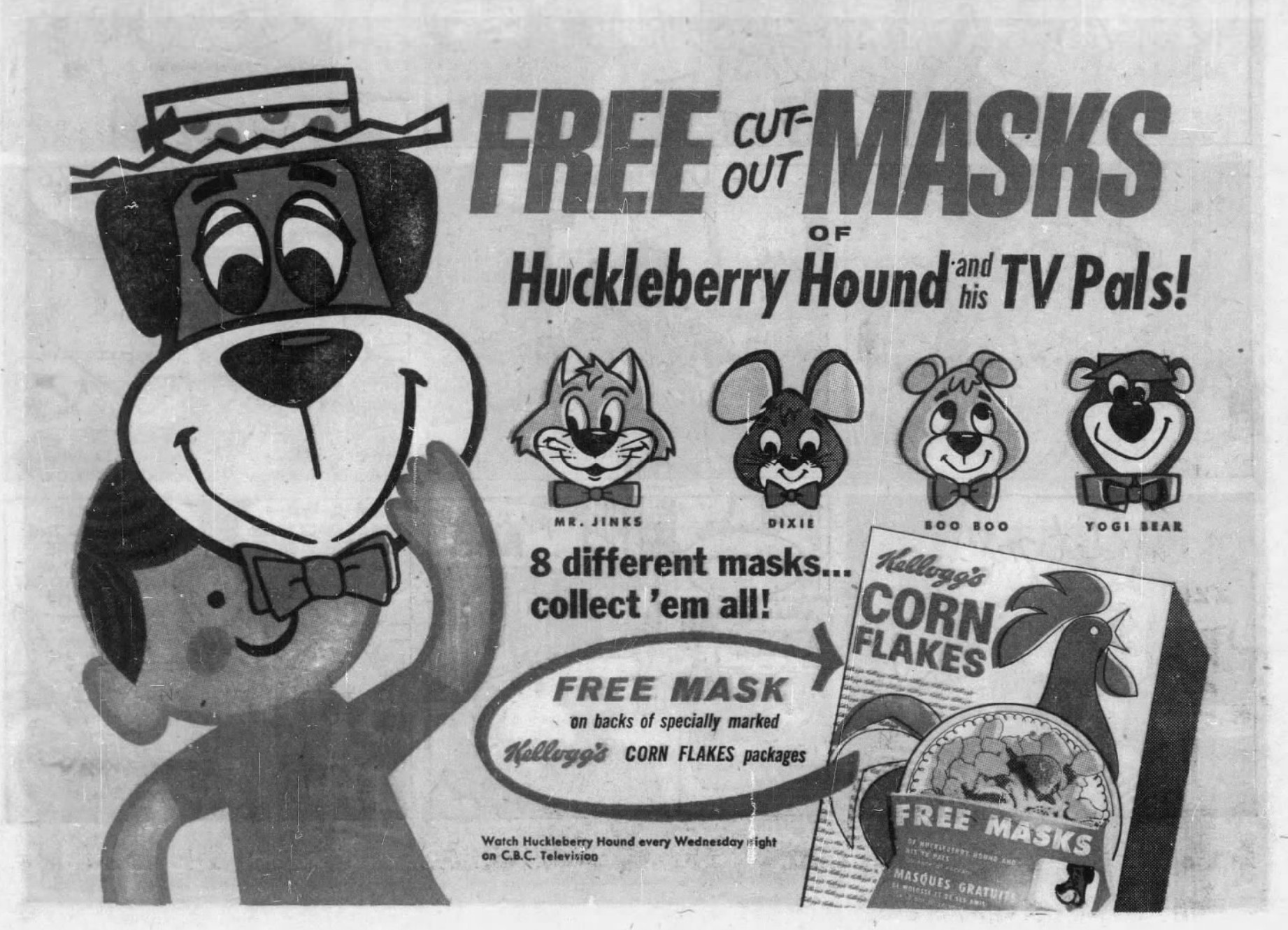
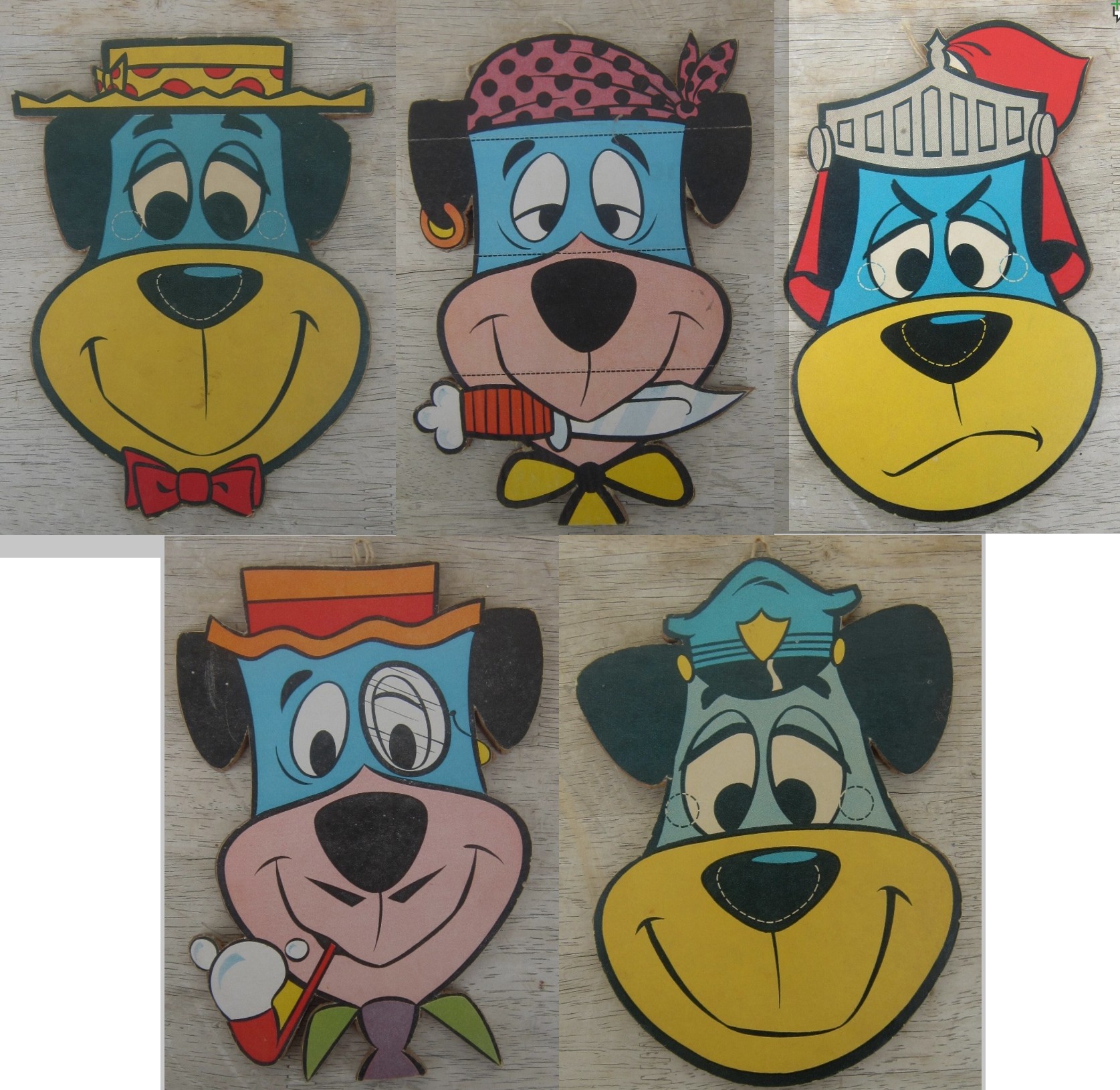
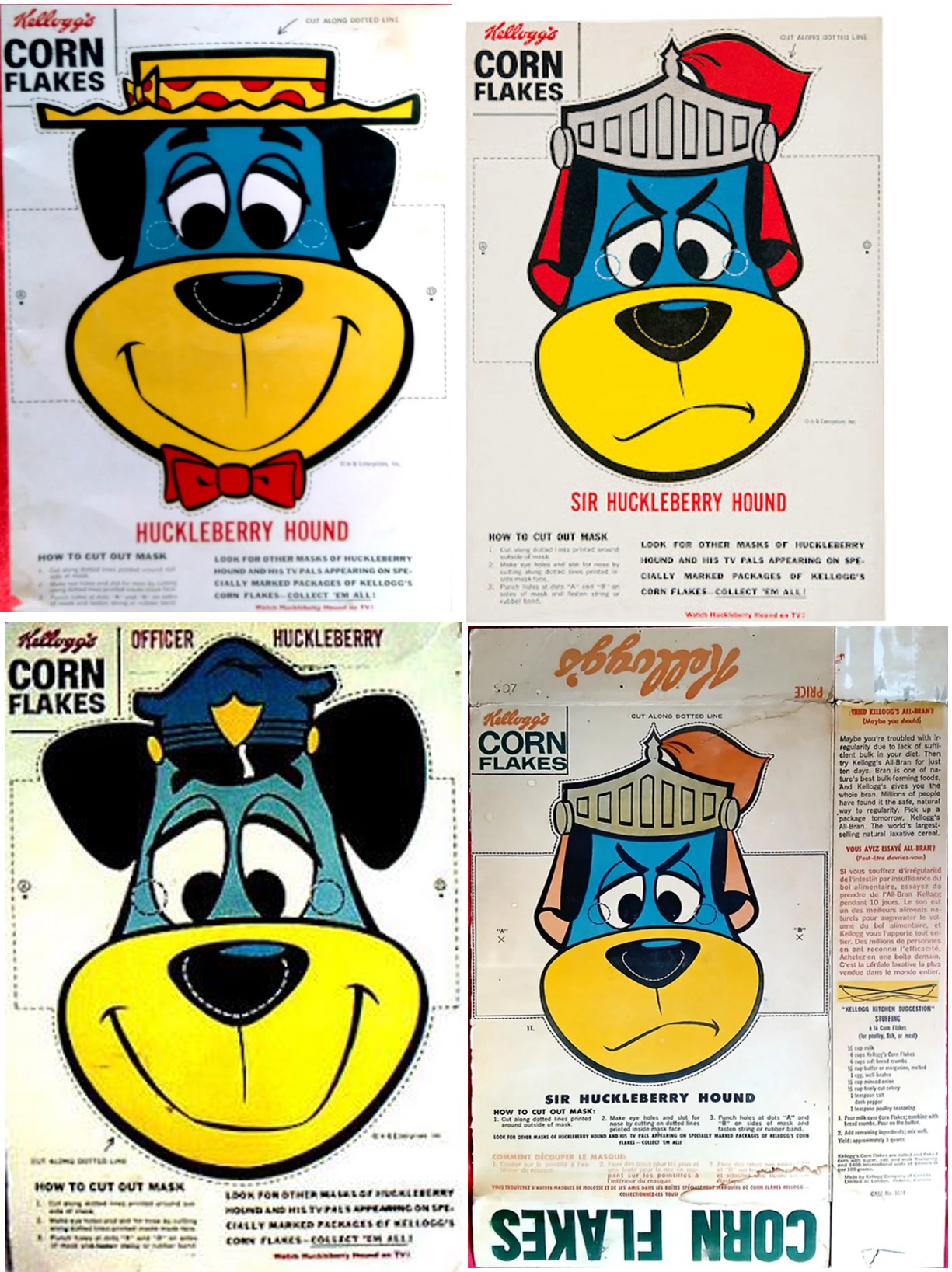
The first image is a 1959 U.S. newspaper advert. The other two are selections of masks and Corn Flakes packets found around the web to illustrate the range of masks available.
Secondly, a Ben Cooper brand of Huckleberry Hound mask was produced in the 1960s. These were sometimes used in the U.S. at Halloween, for parties and so on.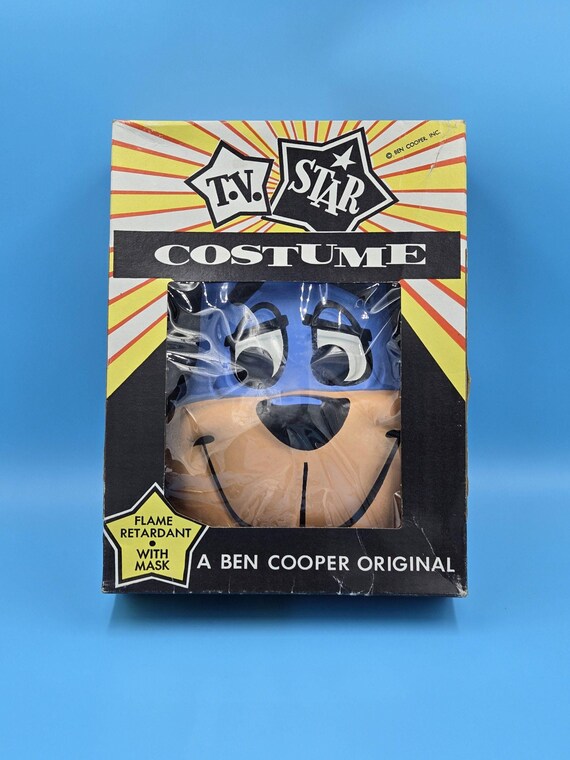
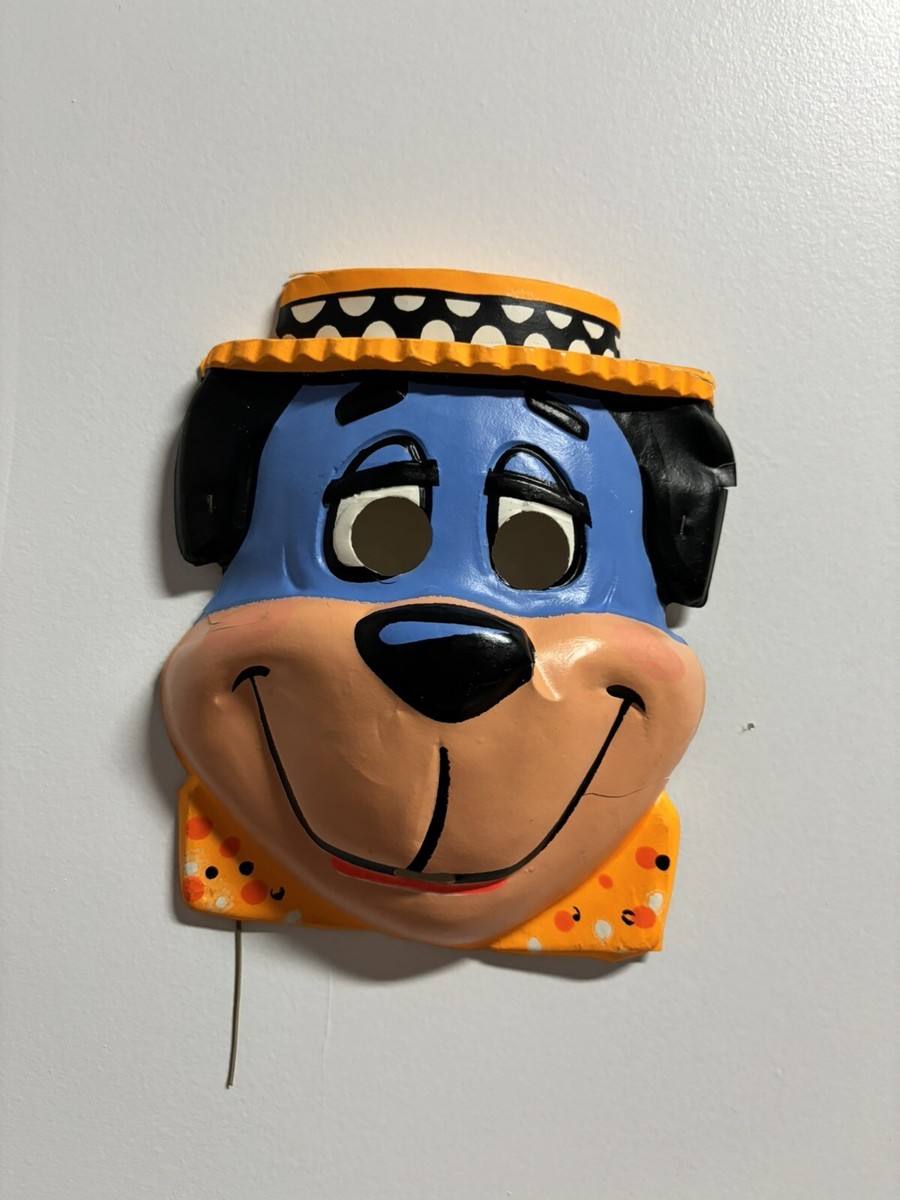
Finally, “full-size head masks” were produced c1964: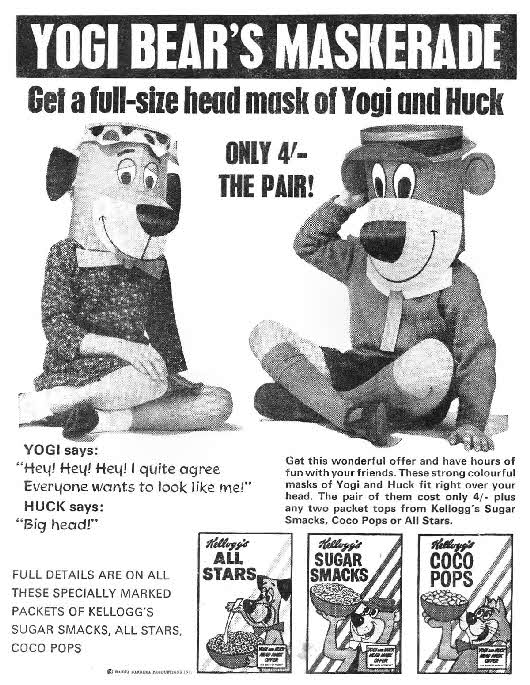
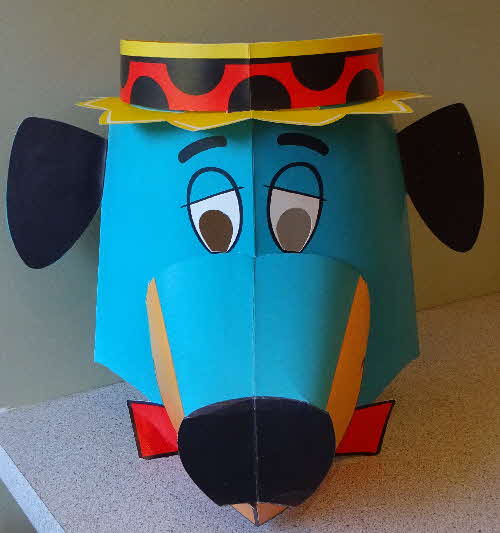
Source: Cereal Offers blog: 1964 – Sugar Smacks Yogi Bear’s Maskerade Send Away Offer
The second and third types of mask have appeared in movies, which seems like it should be be significant.
The second type is briefly worn by Audrey Hepburn as Holly Golightly in Breakfast at Tiffany’s (dir. Blake Edwards, 1961). The film had been shown on BBC-1 on 29 January 1978 and BBC-2 on 1 March 1979.
It’s in the “shoplifting scene”: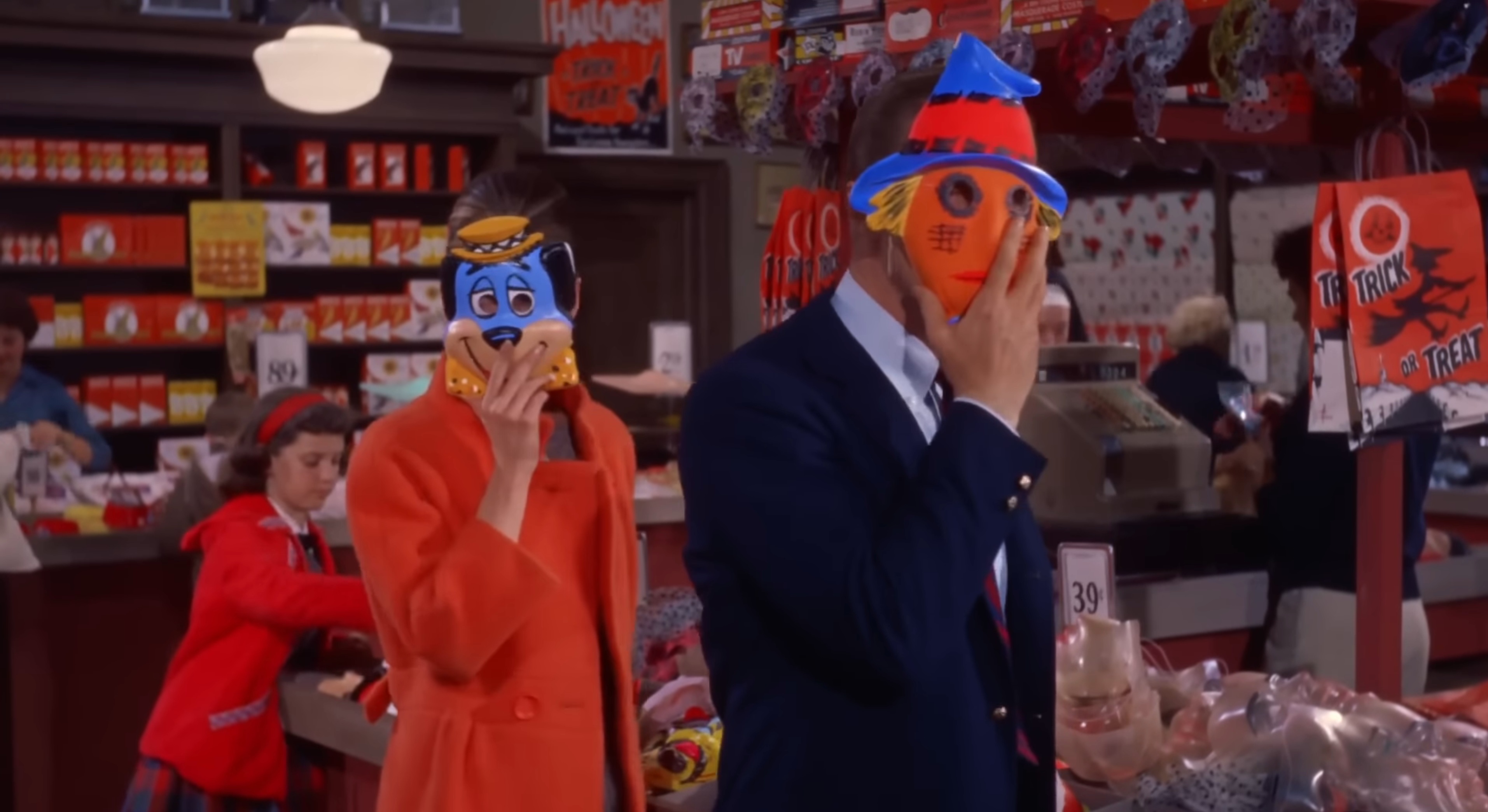
View clip: YouTube
In the same movie Hepburn sings the song “Moon River“, composed for the film by Henry Mancini with lyrics by Johnny Mercer. The lyrics are:
Moon River, wider than a mile
I’m crossing you in style some day
Oh, dream-maker, you heart-breaker
Wherever you’re going, I’m going your way
Two drifters, off to see the world
There’s such a lot of world to see
We’re after the same rainbow’s end
Waiting ’round the bend
My huckleberry friend
Moon River, and me
View clip: YouTube
The third type of mask makes an appearance in Life at the Top (dir. Ted Kotcheff, 1965). Life at the Top hadn’t had a recent national broadcast at the time “In the Park” was debuted, but it’s a memorable scene.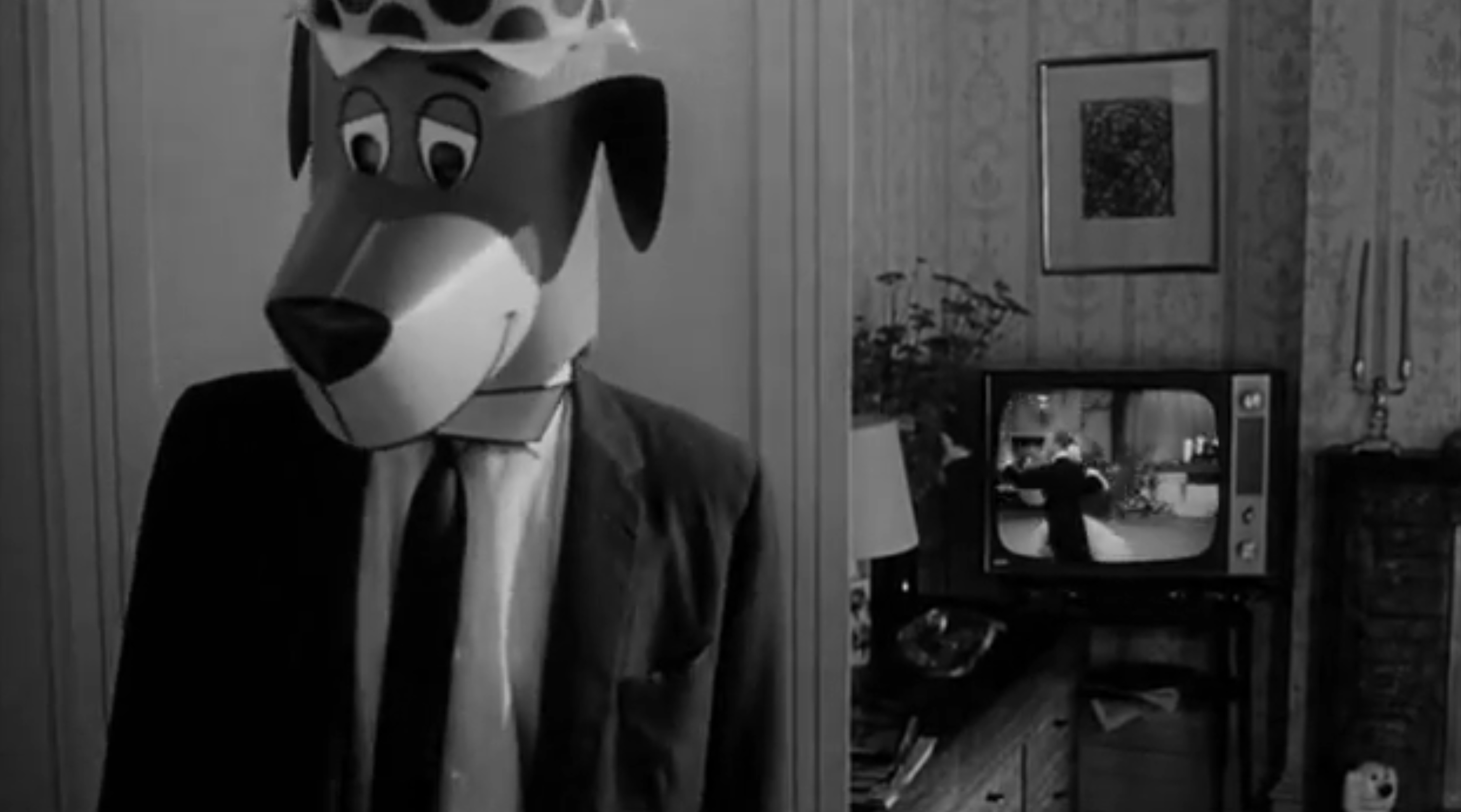
View clip: YouTube
One or other of the above might possibly be the inspiration for the “huckleberry mask” line, although that doesn’t help us understand what it means. ↩︎ - What I currently have here as “kobolds” is more often transcribed as “couples”. I am open to arguments about which is better; “couples” is not implausible, it’s just not what I am hearing. A kobold is a house sprite or goblin out of German folklore. They are regarded as relatively benevolent, often helping out with domestic chores. But they are also mischievous, and if angered they will exact cruel revenge. There is an opera by Siegfried Wagner (Richard’s son) titled Der Kobold (1903).
“You’re saying” might be “You sing” or “You think”. ↩︎
Sources / Links
- The Annotated Fall: “In The Park” [Archived]
- Bury New Road (2022): “Una Baines on The Fall, Prestwich Hospital and that Prestwich energy…” Posted 11 May 2022. [Archived]
- Bury New Road (2023): “The 17th Century Church Inn off Bury New Road.” Posted 21 March 2023. [Archived]
- Colwell, James L. (1971). “Huckleberries and Humans: On the Naming of Huckleberry Finn.” PMLA, Vol. 86 (1), January. pp.70-76. [DOI: https://doi.org/10.2307/461003].
- Erickson, Hal (2016). “Huckleberry Hound.” in Television Cartoon Shows: An Illustrated Encyclopedia, 1949 Through 2003. 2nd ed. Jefferson, North Carolina: McFarland and Company. pp.418-421.
- Ford, Simon (2003). Hip Priest: the story of Mark E Smith and The Fall. London: Quartet Books.
- Johnson, Gemma (2026). “Ghosts of Heaton Park: Haunted Tales from Manchester’s Historic Hall.” Spooky Manchester, 20 February [blog].
- Lock Graham (1980). “Fall in a Pit.” New Musical Express, 29 November. p.37.
- Mackay, Tommy (2018). 40 Odd Years of The Fall. Place of publication unknown: Greg Moodie.
- Marshall, Brad (2020). “Looking Back: Haunted history and hidden secrets of the Church Inn in Prestwich.” Bury Times, 12 August. [Online] [Archived]
- Pouncey, Edwin (1981). “The Prestwich Horror and Other Strange Stories.” Sounds, 31 January. pp.18-19.
- Pringle, Steve (2022). You Must Get Them All: The Fall on Record. [paperback edition]. Pontefract: Route Publishing Ltd. [Online store]
- Pye, Ian (1980). “The Fall: Grotesque (After the Gramme).” Melody Maker, 22 November. p.24.
- Sinker, Mark (1986). “Watching the City Hobgoblins.” The Wire, August. pp.20 – 21, 46.
- Smith, Mark E. (2009). Renegade: The Lives and Tales of Mark E. Smith. London: Penguin.
- The Track Record: “In The Park”
- Underwood, Peter (1978). Ghosts of North-West England. London: Fontana/Collins. [Reprint, Underwood Publishing]
- Wikipedia: Huckleberry
- Wikipedia: Huckleberry Hound