A figure walks behind you
A figure walks behind you
A shadow walks behind you
A figure walks behind you

Days of booze and roses
Shine on us, free us all
Who is not irascible
He is no genius

A figure walks behind you
A figure walks behind you
A shadow walks behind you
A figure walks behind you

The old golden savages killed their philosophers
Thought brought the drought about 1
Something followed me out
Goes out again

A figure walks behind you
A shadow walks behind you
A figure walks behind you
A shadow walks behind you

And if it grabs my coat-tail
I will turn and hit it
It may remove the pegs
Keeping my eyes open

A figure walks behind you
A shadow walks behind you
A figure walks behind you
A shadow walks behind you

It's got eyes of brown, watery
Nails of pointed yellow
Hands of black carpet 2
It's a quick trip to ice house 3
Quick trip to ice house
Quick trip to ice house
Quick trip to ice house

A figure walks behind you
A shadow walks behind you
A figure walks behind you
A shadow walks behind you
You
You
You
You
You
You
You
A figure walks behind you
A shadow walks behind you
A figure walks behind you
A shadow walks behind you
You
You
You

And tales of terror which my father told me
They never scared me
But not only is it the blind who cannot see 4
That figure behind you
Behind you
Behind you
Behind you
You
You

That figure kept on walking
That figure kept on walking
That figure kept on walking
That figure kept on walking behind you
Behind you
Behind you
Behind you

There's a man on my trail 5
There's a man on my trail
There's a man on my trail
There's a man on my trail
And he's also behind you
Behind you
Behind you
Behind you

That figure kept on walking
That figure kept on walking
That figure kept on walking
That figure kept on walking behind you
Behind you
Behind you

A figure walks
A figure walks
A figure walks
A figure walks
Commentary
< post in progress >
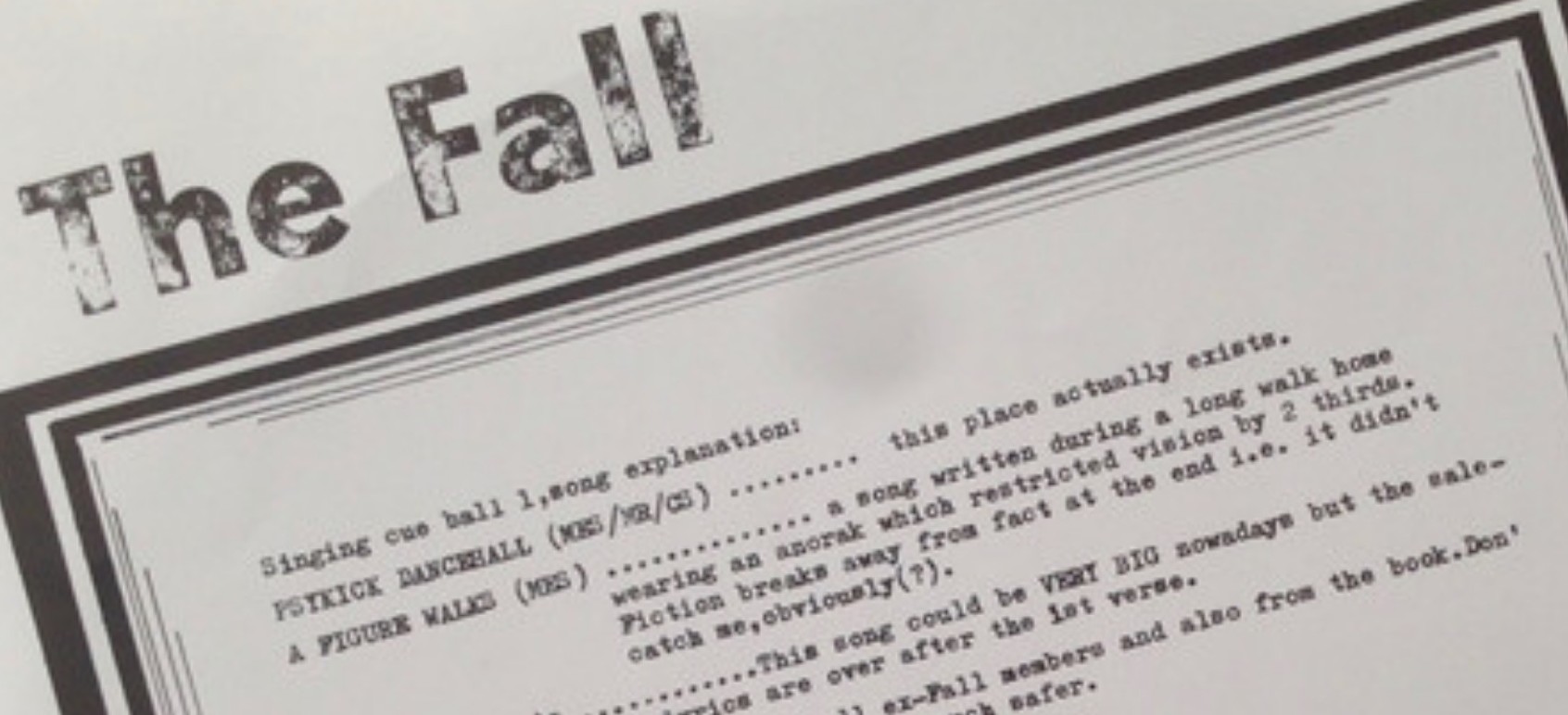
A FIGURE WALKS (MES) … a song written during a long walk home wearing an anorak which restricted vision by 2 thirds. Fiction breaks away from fact at the end i.e. it didn’t catch me, obviously (?).
… I can tell you this: two things came for him by post during those weeks, both with a London postmark, and addressed in a commercial hand. One was a woodcut of Bewick’s, roughly torn out of the page: one which shows a moonlit road and a man walking along it, followed by an awful demon creature. Under it were written the lines out of the “Ancient Mariner” (which I suppose the cut illustrates) about one who, having once looked round –
                     walks on,
And turn no more his head,
Because he knows a frightful fiend
Doth close behind him tread.
James, 1911, p.152
On The Morphology of the “Figure”
M.E.S.’s description of the “figure” is very reminiscent of the style, though not the specifics, of M.R. James’ descriptions of the creature in his short story, “Canon Alberic’s Scrap-Book” (first published in the National Review, March 1895).
“At first you saw only a mass of coarse, matted black hair; presently it was seen that this covered a body of fearful thinness, almost a skeleton, but with the muscles standing out like wires. The hands were of a dusky pallor, covered, like the body, with long, coarse hairs, and hideously taloned. The eyes, touched in with a burning yellow, had intensely black pupils…”
James, 1895 [1984], p.16.
“Pale, dusky skin, covering nothing but bones and tendons of appalling strength; coarse black hairs, longer than ever grew on a human hand; nails rising from the ends of the fingers and curving sharply down and forward, grey, horny and wrinkled.”
“The shape, whose left hand rested on the table, was rising to a standing posture behind his seat, its right hand crooked above his scalp. There was black and tattered drapery about it; the coarse hair covered it as in the drawing. The lower jaw was thin – what can I call it? – shallow, like a beast’s; teeth showed behind the black lips; there was no nose; the eyes, of a fiery yellow, against which the pupils showed black and intense…”
James, 1895 [1984], p.19.
The lyric tells us a few things directly about the figure/shadow/man. First of all, it has legs (it is, after all, walking). Secondly, it has watery brown eyes. Thirdly, it has pointy yellow fingernails. Fourthly, it has hairy black hands (presumably that’s what “black carpet” means) – like M.R. James’ “coarse, matted black hair”.
Footnotes
Note that this line contains two internal rhymes: “thought” and “brought”, and “drought” and “about”. It is curious to observe that “drought” looks like it ought to rhyme with “thought” and “brought”, but doesn’t.
“Life is short and full of thought”, according to “Before the Moon Falls“, also from Dragnet. ↩︎
On 25 December 1978, BBC-1 aired the last of the original run of annual one-off plays in its “A Ghost Story for Christmas” series: The Ice House, directed by Derek Lister, written by John Bowen. The idea of “A Ghost Story for Christmas” was to broadcast a classic ghost story every year. Beginning in 1971, the first five were adaptations of stories by M.R. James, the sixth was “The Signalman” by Charles Dickens, and the final two were original stories. All of them were aired within a few days of Christmas, but only two on Christmas Day itself. ↩︎
A line that also appears in a verse from the song “Let Me Rock You”, by soft-rock band Oscar (formed in Manchester, extant c1969-1978 – some sources say they started in 1973, but press coverage in 1978 gives them an eight-year history): “It’s not only the blind who cannot see / These chains you hang around me / As big as the mountains, as high as the sky / Over the rainbow our love will fly” [Link to YouTube]. The song originally appeared on their 1977 album Cobblestone Heroes, and was subsequently released as what turned out to be their final single in 1978 [Discogs – album] [Discogs- single]. The single was not a hit, but several years later it was covered by British comedy double-act Cannon and Ball on their 1982 album Together [link to Comedy Kings: an unofficial Cannon and Ball website:Together album]. Promotion for the single included an appearance on the Granada TV pop music programme, Get It Together, on 10 January 1978. I don’t know whether this is MES’ source (… or that there necessarily needs to be one, except that the song does contain other lines which do seem to be quotes from other sources), but it’s plausible that it could have been. ↩︎
Strange how the nebulous “figure” or “shadow” becomes a more concrete “man” in this verse. ↩︎
James, M.R. (1895). “Canon Alberic’s Scrap-Book.” reprinted in The Penguin Complete Ghost Stories of M.R. James. London: Penguin, 1984. pp.11-20. [Anthology first published by Edward Arnold, 1931]
James, M.R. (1911). “Casting the Runes.” reprinted in The Penguin Complete Ghost Stories of M.R. James. London: Penguin, 1984. pp.138-155. [Anthology first published by Edward Arnold, 1931]
Mackay, Tommy (2018). 40 Odd Years of The Fall. Place of publication unknown: Greg Moodie.
The “anorak story” is likely insufficient. Smith is probably using a mundane anecdote, like a hooded jacket blocking his view, as a “Northern” shield to deflect from the deep, almost Jungian complexity of his writing. The anorak might be the source of the physical sensation, but the song is clearly a dive into paranoia, the Shadow self, and the burden of the intellect. There is the theme of the artist vs. the “shadow” (“and if it grabs my coat-tail, I will turn and hit it, It may remove the pegs”). Thus the “figure” is an internal antagonist. Pegs represent probably something like the structures that hold a life or a career together. If his “authentic core” (the shadow) grabs his coat-tail, it threatens the stability of the “performer” Mark E. Smith. Thus his urge to “turn and hit it,” in a kind of frantic need to keep the inner darkness at bay so he can keep his “eyes open.” He is terrified that if he looks too closely at his own “watery eyes” and “black carpet hands,” the fragile scaffolding of his artistic “genius” will collapse. “The old golden savages killed their philosophers / Thought brought the drought about” reminds me of the theme in “Witch Trials.” It is an anti-intellectualism, with Smith maybe viewing the audience (“the golden savages”) as a primitive force. They want the “booze and roses” and the “dancehall” rhythm, but they resent the “thought” (the philosophy) that comes with it. Thus, Smith may be scared, as all authors are, that the more he thinks, the more he states the truth, the more he brings a “drought” upon himself, alienating the very people who “shine” on him.”Eyes of brown, watery / Nails of pointed yellow / Hands of black carpet” is a grotesque description. These aren’t the features of a hooded jacket, they are the features of a sick, aging, or neglected body. The “quick trip to ice house” is chilling too. In his Mancurian world, an ice house is a place for storage and preservation, but also carries connotations of the morgue or a place where things go to die or freeze. The “figure” isn’t just following him; it’s herding him toward a cold, static end. “Who is not irascible / He is no genius” is a kind of defense mechanism, maybe. Smith is acknowledging his own difficult personality (irascibility) as a prerequisite for his art. By claiming “he is no genius,” he is trying to lower the stakes. If he’s not a genius, then the “figure” walking behind him can’t take anything important away. It’s a way of protecting that “authentic core” by pretending there’s nothing there to steal. That’s what I hear anyway.


The “anorak story” is likely insufficient. Smith is probably using a mundane anecdote, like a hooded jacket blocking his view, as a “Northern” shield to deflect from the deep, almost Jungian complexity of his writing. The anorak might be the source of the physical sensation, but the song is clearly a dive into paranoia, the Shadow self, and the burden of the intellect. There is the theme of the artist vs. the “shadow” (“and if it grabs my coat-tail, I will turn and hit it, It may remove the pegs”). Thus the “figure” is an internal antagonist. Pegs represent probably something like the structures that hold a life or a career together. If his “authentic core” (the shadow) grabs his coat-tail, it threatens the stability of the “performer” Mark E. Smith. Thus his urge to “turn and hit it,” in a kind of frantic need to keep the inner darkness at bay so he can keep his “eyes open.” He is terrified that if he looks too closely at his own “watery eyes” and “black carpet hands,” the fragile scaffolding of his artistic “genius” will collapse. “The old golden savages killed their philosophers / Thought brought the drought about” reminds me of the theme in “Witch Trials.” It is an anti-intellectualism, with Smith maybe viewing the audience (“the golden savages”) as a primitive force. They want the “booze and roses” and the “dancehall” rhythm, but they resent the “thought” (the philosophy) that comes with it. Thus, Smith may be scared, as all authors are, that the more he thinks, the more he states the truth, the more he brings a “drought” upon himself, alienating the very people who “shine” on him.”Eyes of brown, watery / Nails of pointed yellow / Hands of black carpet” is a grotesque description. These aren’t the features of a hooded jacket, they are the features of a sick, aging, or neglected body. The “quick trip to ice house” is chilling too. In his Mancurian world, an ice house is a place for storage and preservation, but also carries connotations of the morgue or a place where things go to die or freeze. The “figure” isn’t just following him; it’s herding him toward a cold, static end. “Who is not irascible / He is no genius” is a kind of defense mechanism, maybe. Smith is acknowledging his own difficult personality (irascibility) as a prerequisite for his art. By claiming “he is no genius,” he is trying to lower the stakes. If he’s not a genius, then the “figure” walking behind him can’t take anything important away. It’s a way of protecting that “authentic core” by pretending there’s nothing there to steal. That’s what I hear anyway.