

Lyrics
Your nervous system, your nervous system, your nervous system, your nervous system

Underground medicine, underground medicine, underground medicine, underground medicine 1

A spark inside
Ten percent that I hide 2
And when it clicks
There's no resist

Every time I hear a new baby cry
I thank my spark inside

And you get underground medicine
Underground medicine
I'm but a nervous system
Underground medicine

I found a reason not to die
A reason for the ride
The spark inside
When it hits the mind you get
Underground medicine
Underground medicine
I'm but a nervous system
Underground medicine

I had a psychosomatic voice 3
And one time it might come back
[Now! It's back] 4

Underground medicine
Underground medicine
I'm but a nervous system
Underground medicine

On my pants I spilled expectorant 5
And the colonel shot better with thirty pints 6
They took his cup away
Take it away, take it away

[Used to 'ground] medicine
[Used to 'ground] medicine
[Used to 'ground] medicine
Commentary
< Post in progress >
“I have this natural thing in me which hates following the logically obvious and detests current modes regardless of their credibility or quality” – From U.Medecin by R.Totale XVII
From the press release for Totale’s Turns (1980)
“Underground Medecin” (sic) first appeared on The Fall’s debut album, Live at the Witch Trials (1979). It is credited to Mark E. Smith and Martin Bramah.
Live, the documented debut of “Underground Medecin” was at the Carlton Club, Warrington, on 13 November 1978 (however, note that we lack setlists or recordings for the preceding seven gigs, so we cannot say for certain that it wasn’t played prior to Warrington). Its last known performance in this period was at the Lyceum, London, on 25 March 1979, but gigs during this period are not well-documented and it’s not impossible that it remained a regular in the set until Bramah left the group in April. But then it was resurrected at the Marquee, London, on 24 July 1980 and was played a handful of times through to November that year, when it was dropped forever.
My sense is that the song is relatively neglected, despite being, in the words of The Track Record (quoting from the Gladys Winthorpe column in The Pseud Mag, #11, August-September 2006), “possibly the most innovative track, at least musically, on the band’s first album”. Steve Pringle draws attention to “Bramah’s guitar work, an explosive blues-garage-punk-surf-rock hybrid.” (2022, p.43).
Lovecraft’s ‘Cthulhu’ Mythos you mean, Is the ‘Totale’ thing an offshoot of that then, what are it’s origins?
“Totale started out on ‘Dragnet’, I mean these things can’t be connected but you’ve heard ‘Underground Medicine’ on the first album which is very Burroughsesque. William Burroughs had apparently written a lot of stuff on the same theme ‘Underground Medicine’ going along in circuits of body abuse and body benefit and therefore you can survive forever.
I sort of visioned this thing where there would be a book called ‘Underground Medicine’ which would be just statements and so Roman Totale comes into that and he’s a voice that the band can speak through.
Mark E. Smith, interview with Edwin Pouncey (AKA Savage Pencil). Pouncey’s question follows on from a discussion about “The N.W.R.A.“, where M.E.S. links Totale to Lovecraft. See Pouncey, 1981, p.18.
“Who knows what the fuck this is all about?” asks Tommy Mackay (2018, p.23), giving up perhaps a tad prematurely. Simon Ford’s only comment on “Underground Medecin” is that is is “one of many tracks on the album riddled with drug references” (2003, p.60). Steve Pringle agrees: “another drug-related lyric” (2022, p.42). Neither Ford nor Pringle seem to be completely incorrect, but the general theme, to judge by M.E.S.’s comment, is both broader and stranger than they suggest.
Is the spelling “medecin” supposed to be a fancy bit of French (meaning “doctor”)? Or was nobody brave enough to point out the error to M.E.S.? It was spelled inconsistently on setlists.
“Burroughsesque” – What is “Underground Medicine”?
In the year 2014 New York, world center for underground medicine…
William Burroughs. From his column, “Time of the Assassins”, in the July 1977 edition of the magazine Crawdaddy.
Footnotes
- The first two “Your nervous system” phrases are chanted acapella by M.E.S. Then Martin Bramah joins in with the chant and the group start playing. After the fourth “Your nervous system”, M.E.S. switches to chanting “Underground medicine”, while Bramah continues with “Your nervous system.” ↩︎
- The old Lyrics Parade, and current The Fall Online – Discography, had/have this as “[Traverse up my hide]”. The handwritten draft lyric sheet reproduced in the Blue Book has “Ten percent that I hide”. ↩︎
- The story is that Mark E. Smith lost his voice and couldn’t record his vocals, as a result of which the group ended up squeezing all the recording for Live at the Witch Trials into two days.
Martin Bramah:
“… we were booked into a studio in London for seven days – but Mark lost his voice on day one and as the plan was to play the songs live in the studio this was a bit of a problem. Our label sent him to see a doctor and we were told to do nothing until he was fixed – so we fucked about in the studio for five days driving the staff nuts (at least we got a good drum sound!) until Mark turned up on the Saturday with two days to go, and so we recorded the album in one day and mixed it on the final day (Sunday).“
(Source: “An interview with Martin Bramah, courtesy of Noisette Triangle and the Factory Star Facebook page.”, posted to Fall News, 30 December 2009). ↩︎ - This needs checking! ↩︎
- “Pants” usually means “underpants” in British English, but there are regional variations where the word can mean “trousers”, as it does in American English. I think that’s what is intended here, and I think that’s what M.E.S. usually means. For example, in Renegade he talks about “going to work in my shirt and pants, normal-like” (Smith, 2009, p.29).
An “expectorant” is a medicine which, according to the Shorter Oxford English Dictionary, causes “increased production of sputum… facilitating clearance of the bronchial passages.” See also Wikipedia.
Note that dextromethorphan (DXM), the active ingredient of many cough syrups, has a history of ab/use for psychedelic purposes – but DXM is a cough suppressant, not an expectorant. See Molecule of the Month: Dextromethorphan (DXM) – The cough medicine that causes hallucinations in high doses (written by Paul May, University of Bristol, posted February 2024) [Archived]. ↩︎ - Possibly inspired by the widely reported case of Dr. Clive Arkle, who unwisely claimed that alcohol improved his aim during a court appearance to appeal against a police decision not to renew his firearms license. The “thirty pints” thing is specifically mentioned in most of the coverage.
The headline in the Daily Mail is closest to the lyric, albeit Arkle was not a “colonel”, but a surgeon Lieutenant in the Royal Naval Volunteer Reserve: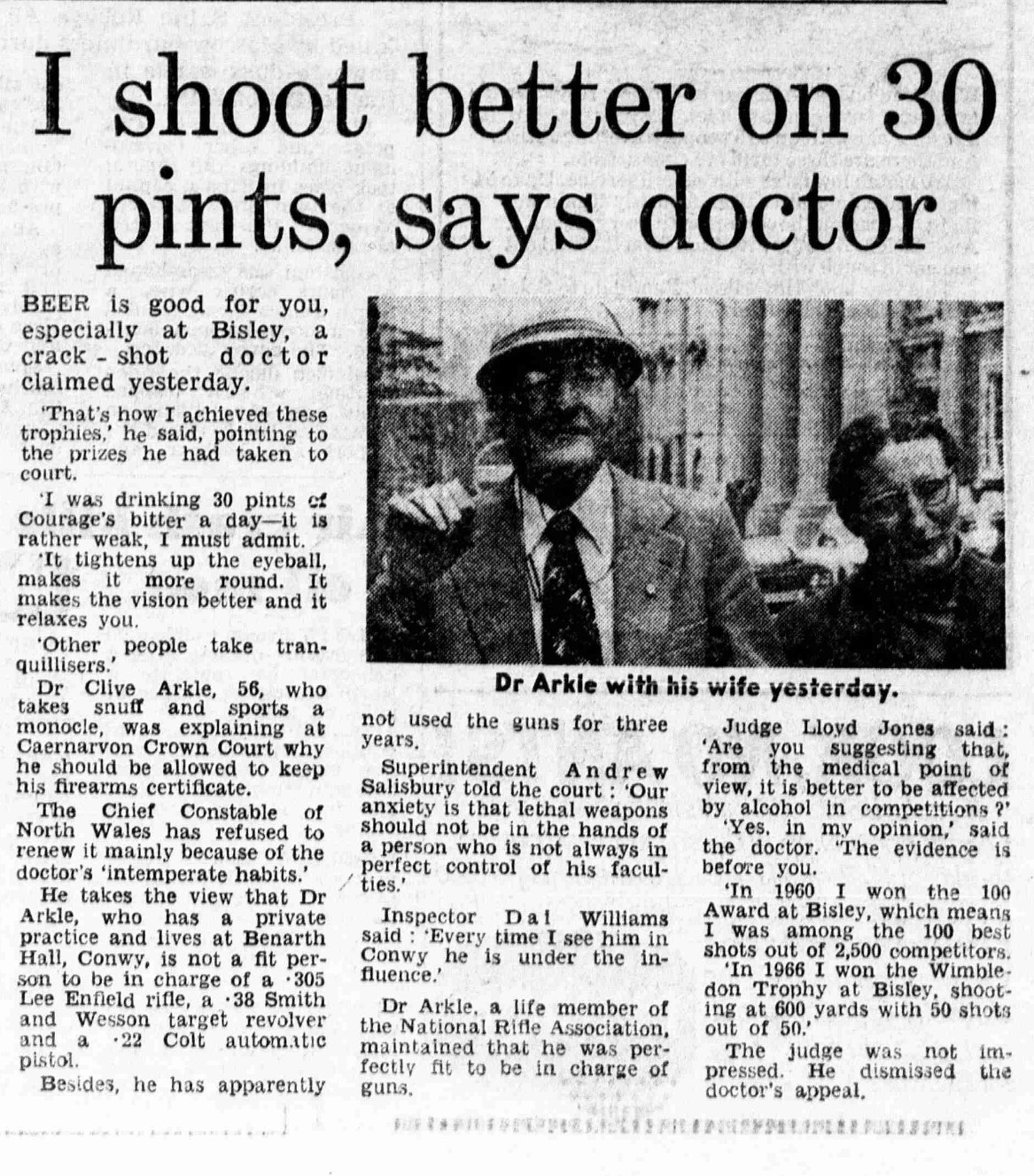
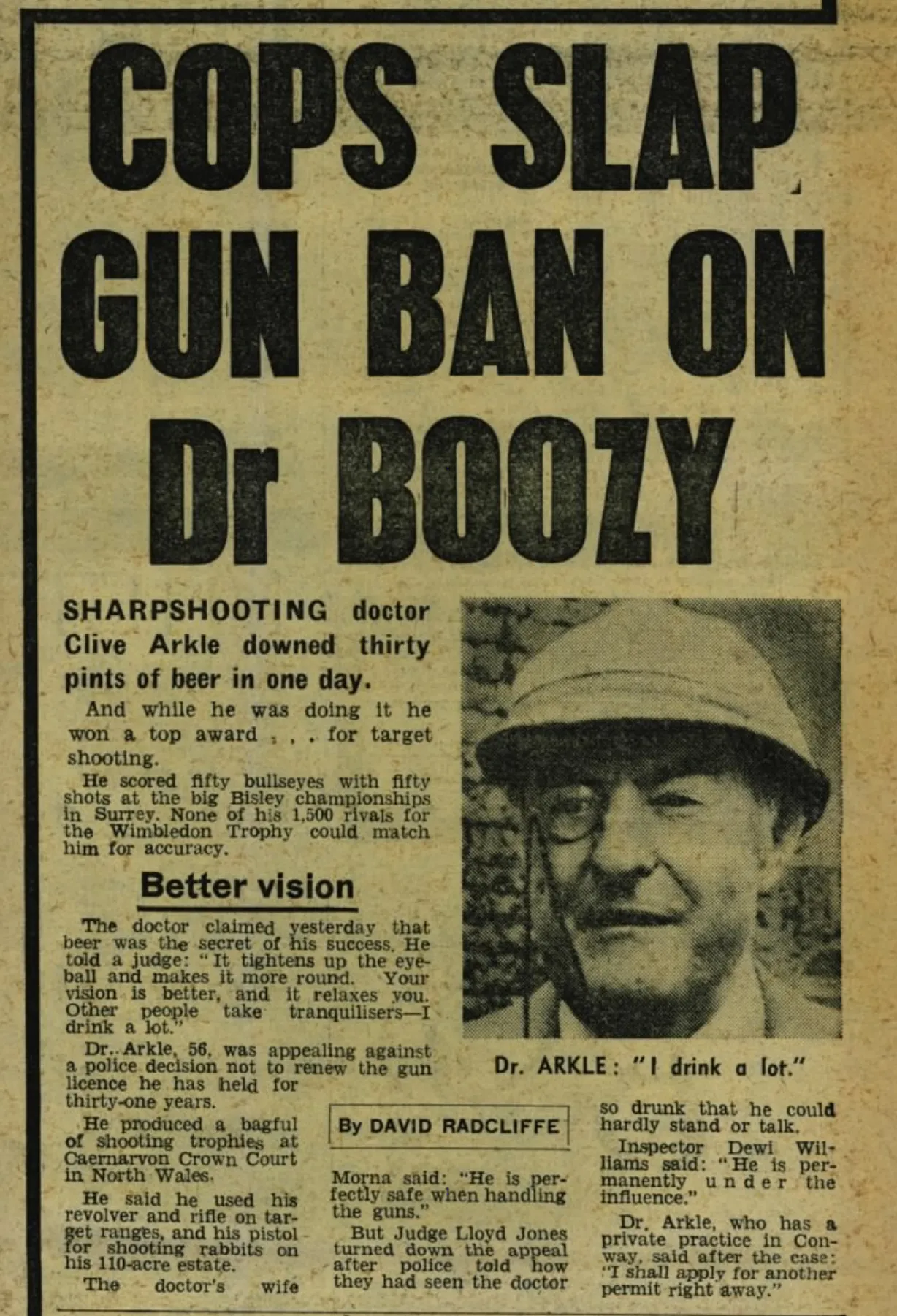
Arkle died of a stroke in 1991, aged 68.
↩︎
Sources / Links
- The Annotated Fall: “Underground Medecin” [Archived]
- Ford, Simon (2003). Hip Priest: the story of Mark E Smith and The Fall. London: Quartet Books.l
- Mackay, Tommy (2018). 40 Odd Years of The Fall. Place of publication unknown: Greg Moodie.
- Pouncey, Edwin (1981). “The Prestwich Horror and Other Strange Stories.” Sounds, 31 January. pp.18-19.
- Pringle, Steve (2022). You Must Get Them All: The Fall on Record. [paperback edition]. Pontefract: Route Publishing Ltd. [Online store]
- Smith, Mark E. (2008). vII. The Lough Press & AMarquisManipulationProductions. [AKA the Blue Lyrics Book]
- Smith, Mark E. with Austin Collings (2009). Renegade: The Lives and Tales of Mark E. Smith. London: Penguin. (Originally published by Viking, 2008). [Available online in the Internet Archive]
- The Track Record: “Underground Medecin”
“Underground Medicine” serves as a frantic, neurological anthem for self-preservation, where the “spark inside” represents a hidden, resilient core of the human psyche that resists external control. By reducing himself to “but a nervous system,” Mark E. Smith strip-mines the human experience down to raw electrical impulses and “psychosomatic” voices, suggesting that true survival—the “reason not to die”—comes from a private, internal chemistry rather than traditional doctors or societal norms. The surreal imagery of “expectorant” and the “colonel” drinking thirty pints further reinforces a theme of bodily dysfunction and the chaotic, DIY methods people use to medicate their own existence within a cold, industrial environment. Puns abound: Our brains are literally nervous systems, but the protagonist underlines how “nervous” his (economic/social) “system” feels. The “spark” could be the very little, the most minimal, part of his life that remains in this oppressive atmosphere, but it could also represent the biggest part of us, our human spirit that is awake, crackling, charging, aware, the part that can’t be choked. On the other hand, the only part that is alive is this “spark.” The world around drains his 90%, but this is the 10% it can’t touch, the part that empathizes with the baby crying for comfort as his own “spark” similarly craves. But the crying baby reminds him of the part of him that is still alive, that can still feel, and feel for a vulnerable child, as well as the vulnerable child he still feels as an adult.The only solace he can find is the underground medicine, a drug, but because it comes from the underground, you just know, without Mark telling us, that it won’t really “be a reason not to die” even while he convinces himself in desperation that it will be. There’s a lot of power and beauty in these repetitive, minimalist words.